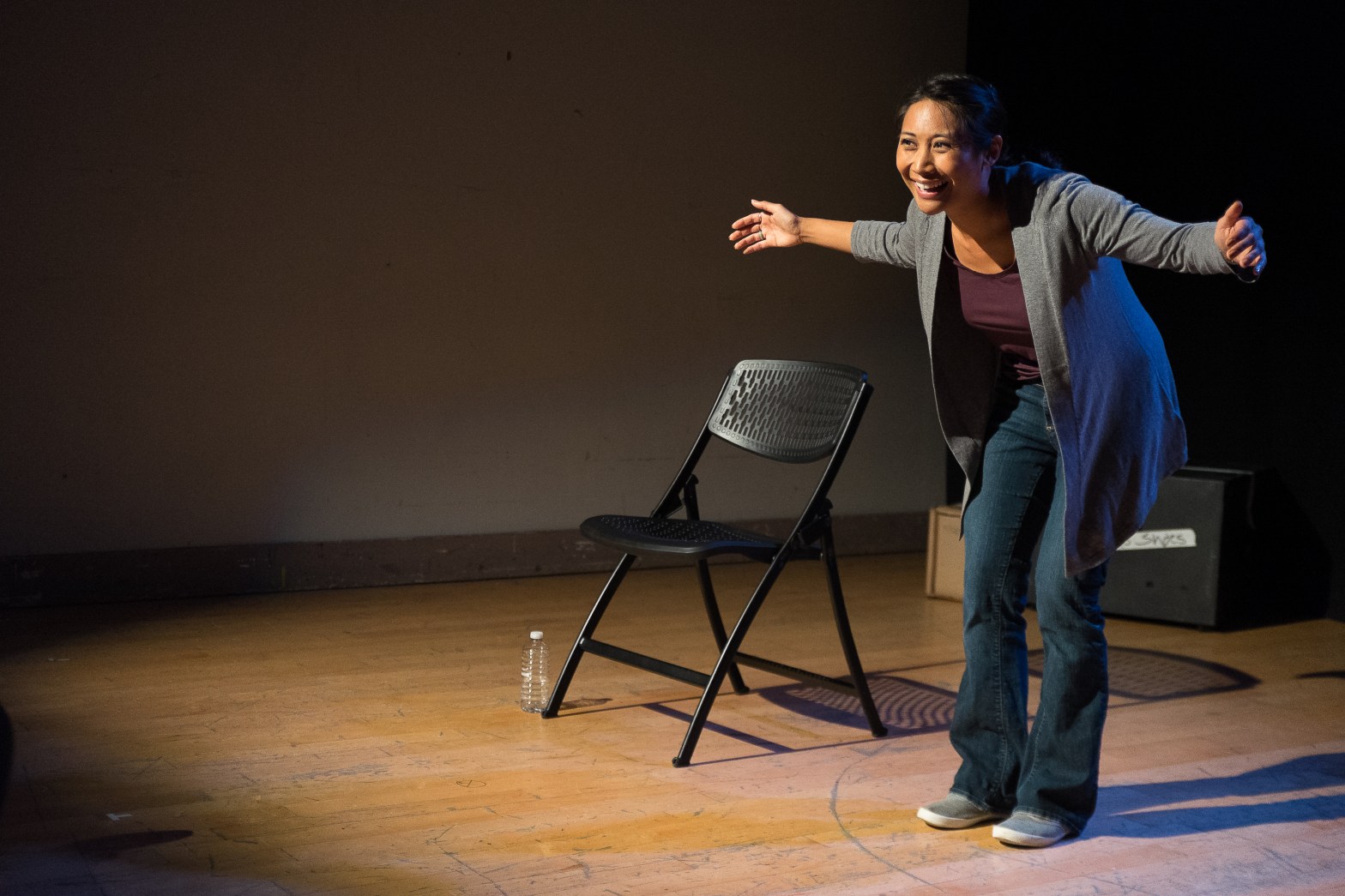
At the beginning of Forgetting the Details, a one-woman show performed by actress-comedienne Nicole Maxali, she — narrating as a present-day version of herself — turns to the audience and asks: “Are memories enough when people and places are no longer there?” The show, which is featured as part of this year’s New York International Fringe Festival (FringeNYC) at The White Box, continually asks this question throughout the next hour and a half, as Maxali takes us back to her childhood in San Francisco, where she was selflessly raised by her grandmother, or Lola, as it is called in Tagalog.
Maxali deftly switches from character to character as she re-enacts her experiences growing up in a very Filipino, unusually American household. There’s Lola Encar, the eccentric but loving grandmother who raised her as her free-spirited artist-musician father Max whiled away the hours playing along to Jimi Hendrix records and smoking things that weren’t the “cigarette kind” in their basement. Then there’s Nikki, a past version of Maxali, who is every bit the opposite of what a “good” apo, or grandchild, should be (which is to say: she wasn’t a virginal, Tagalog-fluent, conservatively dressed young woman with a nursing degree). Through these characters, Maxali looks back at these snapshots in time with a careful, sensitive eye, taking us all on an emotional journey. For young Nikki, everything starts to change when she comes home one day to find the door locks changed, and Lola Encar frantically pleading to go to the police station. Soon, more confusing behavior occurs, and after a “hearing” test, the doctor confirms that it is early onset Alzheimer’s Disease. Now, not only do Nikki and Max each have to cope with the pain that only a disease like Alzheimer’s can bring, but also re-evaluate their own lives, making sacrifices for the one person who sacrificed everything for them. This means having to prioritize family above all else — including their art. For Nikki, crumbling under pressure to be a “good” apo also means leaving her acting dreams on the back-burner.
The show’s title may seem to only refer to Lola Encar’s diminishing memory at first glance; however, by the show’s end we realize that it’s not just Lola Encar who forgets the details, but Nikki, as well. The same memories she has of Lola cooking Filipino-American mash-ups (sweet spaghetti with hot dogs, anyone?) and handing out ice cream to her second-grade classmates during recess are vivid and yet start to slowly fade into obscurity in her Lola‘s absence. In a scene entitled “I Heart Lola,” Maxali proudly states: “Lolas show their love through food, through cooking, through acts of service…the first question in any Filipino household is, ‘Have you eaten yet?'” And just as her Lola‘s dishes nourished her body and soul, we also leave the theater nourished by Maxali’s dazzingly honest performance. She serves up a perfect blend of comedy and tragedy with a dash of some unique charm — all lovingly brought together the same way her own Lola would in the kitchen. The end result is a pot-belly full of laughter, tears and a heart full of warmth, all of which will make you want to dig up those old photo albums and hug your own Lola.
Images courtesy of Mike Ricca.Forgetting the Details ran from August 13-22at The White Box (440 Lafayette Street between Astor Place and East 4th Street) as part of the New York International Fringe Festival (FringeNYC). For more information on this production and Ms. Maxali’s other works, click here. For more information on FringeNYC, go here.
How must one transform oneself in order to be fulfilled as an artist, especially if one is a woman? And what sacrifices must be made in order for that to happen? Welcome to the first installment of FILM STRIPS, where I share with you some of my favorites and hopefully have some fun deconstructing them along the way. Here, I submit for tonight’s double feature Darren Aronofsky’s Oscar®-winning Black Swan (2010) and Rob Marshall’s controversial Memoirs of a Geisha (2006). Both films immerse the viewer in two worlds which seem different, but actually are much similar at second glance: the former, a ballet company in modern-day New York City; the latter, a geisha house in 1930s Japan. Both worlds, despite being inhabited mostly by women, find themselves at the hands of powerful men.
A nod to the Hans Christian Andersen-penned classic The Red Shoes, Aronofsky’s film tells the story of Nina Sayres (Natalie Portman), a corps dancer who dreams of becoming a prima ballerina. On the cusp on a new season, Nina’s dance company undergoes preparations for an exciting new production of Swan Lake. Obsessed with nabbing the lead role as the Swan Queen, sweet and innocent Nina desperately tries to convince the show’s director Thomas Leroy (Vincent Cassel) that she can play both sides which inhabit the Swan Queen: not only the equally pure White Swan, but also the dark Black Swan. What results is a psychological breakdown which has Nina sacrificing the most important thing of all: herself.
Memoirs follows young Chiyo, a fisherman’s daughter who sold to an okiya, or geisha house,when her mother falls ill. Not understanding the more lenient fate she is given compared to that of her sister Satsu, who is sent to a house in the Pleasure District, Chiyo at first defies house rules, racking up a debt which eventually bars her from her future as a geisha. Years pass until the fate of now-teenage Chiyo (Zhang Ziyi) is lent a hand, in the form of a mysterious veteran geisha, Mameha (Michelle Yeoh). Under Mameha’s tutelage, Chiyo blooms into Sayuri, the most desired geisha in the the whole hanamachi. However, with success comes its burdens, and Sayuri must choose between a life of love and the life of a geisha.
Watching these two films back-to-back recently, what struck me the most were their similar themes of sacrifice for the sake of art, the rivalries that often occur between women, and of course the powerful men who control them. While both Nina and Sayuri have very different objectives at the start of their respective journeys (Nina wishes to be prima ballerina while Sayuri takes on the task of becoming geisha to get closer to the Chairman [Ken Watanabe], the man she has loved since she was a little girl), they both endure much physical and emotional pain to get there. In Swan, there is a short scene in which, one-by-one, Nina and her mother prepare various pairs of pointe shoes, ready to be broken in. For many dancers, the process is familiar: the burning of the toes, the scraping of the sole, the sharp needle threaded through silky ribbon.
The moment in the film is brief, but it called to mind another film where the same process is shown: Nicholas Hytner’s Center Stage (2000). One of my favorite moments ever in a dance film (nay, perhaps the favorite), is a montage showing dancers breaking in their shoes in Center Stage—it is a time-consuming act, but is demonstrative of the rigor and discipline which governs the lives of ballet dancers. We see this in the case of geishas, as well, through a similar montage in Memoirs, during which Sayuri learns the practice of becoming a geisha. As Mameha states: “Agony and beauty for us live side-by-side,” a theme that is resonant throughout both films:
Another parallel between the two films is, of course, the interactions among the women; particularly the idea of the young ingenue replacing the prima donna figure. In the world of ballet, this is represented through the role of Beth Macintyre (Winona Ryder), a former principal dancer for the company who, like Nina, was also famously favored by Leroy. Not long after we are introduced into the world of ballet at the film’s start, we learn that Beth is being phased out of her place as prima ballerina, eventually making way for Nina to make the official transition. However, Beth isn’t going without a fight, and confronts Nina after the company’s launch party for their Swan Lake production, asking the younger dancer what she had to do to get the role.
Similarly, in Sayuri’s world, Hatsumomo serves as the reigning “prima donna” of sorts; one of the most desired geishas in the whole hanamachi, Hatsumomo provides the means necessary to keep the okiya running. In their first encounter, Hatsumomo finds a young Chiyo in her room and immediately chides the girl for touching her things. That encounter is then mirrored once Chiyo becomes the successful and desirable Sayuri, as she now holds ownership of Hatsumomo’s former quarters. This time, it is Hatsumomo who trespasses — in more ways than one. What happens next is a confrontation that quickly escalates, resulting in Sayuri coming to the following realization:
“I could be her. Were we so different? She loved once, she hoped once. I could be her. I might be looking into my own future.“
It’s not just the prima donnas that try to get in the way of these two protagonists. Other female characters in both films seek to derail each respective protagonists’ goals. In Swan, there’s the mysterious Lily, the eponymous Black Swan whose darker inclinations only help to further Nina into madness; as well as bad girl Veronica (Ksenia Solo), who becomes bitter and suspicious when it is Nina that nabs the role of the Swan Queen. In Memoirs, when Sayuri finally has a chance to be with the Chairman, it is her childhood companion Pumpkin (Yuki Kudo) who plots to have the chairman’s best friend and confidante Nobu (Koji Yakusho) waiting for Sayuri instead.
However, though the two films center on a world of women, we must not forget it is one that is ruled by men. For Swan‘s Nina Sayres, it’s Thomas Leroy; as for Sayuri in Memoirs, it is the various men acting as patrons (danna): The Chairman, Nobu, Dr. Crab and perhaps more ominously, Mameha’s danna, The General. These powerful men of influence assert their power over the women the only way they know how: by taking advantage of them. Scenes in which Leroy kisses Nina during rehearsal and The General forces Sayuri’s robes off of her behind closed doors prove that sometimes there is a higher price to pay for your art.
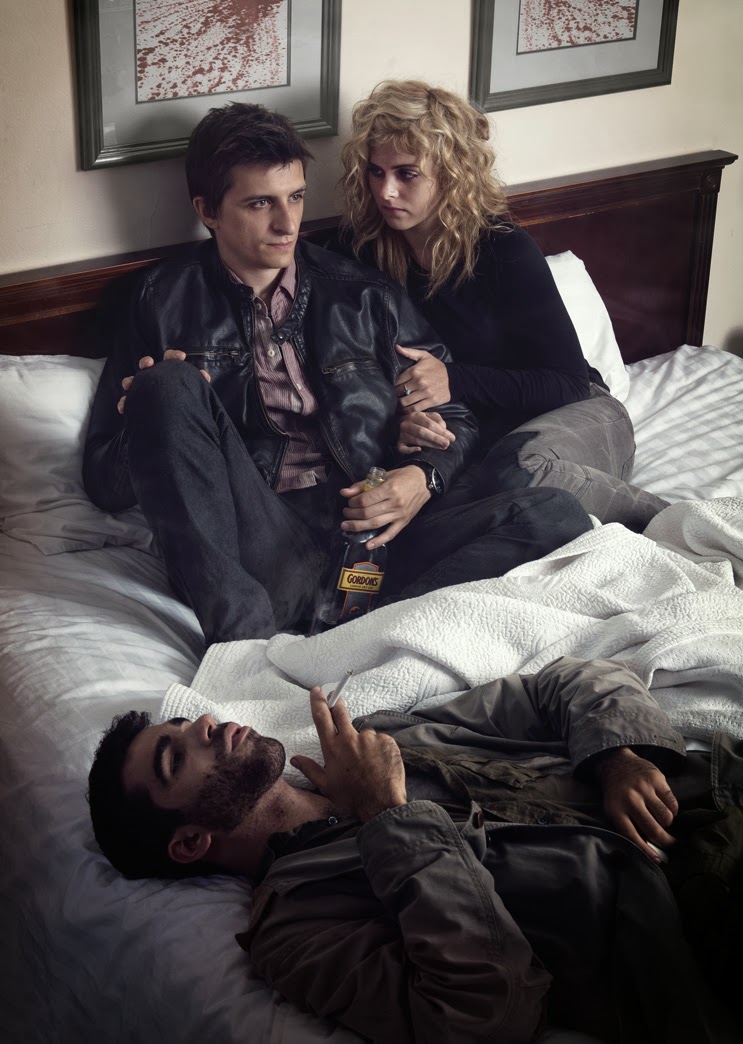
The scene is simple: a hotel room in Leeds — the kind, as it is written, that is so expensive it could be anywhere in the world. So begins the most powerful two hours you’ll ever spend in the theater. Set against the tumult of an apocalyptic England, Blasted is a daring work by infamous British playwright Sarah Kane, which explores how a single act of violence over the course of one night can have quite literally earth-shattering repercussions. Written in 1995 at the tail end of the Bosnian war, the play sought to challenge the desensitization to which our culture often submits in the face of violence. Using the Bosnian conflict as a starting point, Kane toyed with the premise that the brutalities of civil war were not unlike those experienced in, say, a small hotel room in Leeds.
This astounding debut put Kane on the forefront of public debate, as it was met with much criticism and shrugged off as just another example of a young dramatist desperate to shock. Much of that criticism seemed to be forgotten by the time it made its way across the pond for its NYC premiere in 2008. Now, 18 years after making its debut at the Royal Court Theatre Upstairs in London, Kane’s play still resonates as our nation is on the cusp of possibly entering yet another war.
At the play’s start we find 45 year-old Ian and his 21 year-old ex-lover Cate at the hotel, looking to spend the night. In just the first few scenes, we already get a sense of the themes Kane intends to dissect over the course of the play as Cate and Ian discuss everything from love to death to even racism. Of course, it is the theme of violence that dominates; particularly, in the parallels between war itself and the atrocities the characters inflict upon one another. The first act of violence happens after the first blackout and we learn that Ian, after many attempts to coax her into bed in the previous scene, has finally had his way and raped Cate. As she awakes to find herself wrapped in blood-stained sheets, a war starts to rage – both outside the hotel and within the enclosed space to which we are privy. Silently resolving to take her leave, Cate feigns going to the bathroom to shower and eventually escapes, leaving Ian alone. Just moments later, an unnamed soldier eventually finds his way into their room and encounters Ian. After the hotel is then blasted by a mortar bomb. The soldier interrogates Ian further, their exchange foreshadowing the brutality that’s to come.
It was interesting for me to revisit this particular piece of work after 5 years, especially when the previous production had been so ingrained in my memory. It was the first time I have ever had to do so, and it felt much like diving back into a favorite book and getting something out of it that you hadn’t the first time around. Every few minutes during the performance, I kept wondering to myself how they would do certain scenes and it was exciting to see the choices that were ultimately made.
Under Will Detlefesen’s direction, the 2013 production by the Cryptic Fascinations Theater Company achieves in continuing Kane’s legacy. The company was formed by actors Marié Botha and Jason de Beer (who play Cate and Ian, respectively) after the two, who also happen to be a couple, had performed a scene together on a whim and decided to make a full production of the play. The production itself, which was held at the Duo Theater on the Fourth Arts Block, was an ambitious one. With a sleek set design by Jason Sherwood and beautiful simplistic costumes by Olivia Hunt, it was clear that though this was a mostly student-run show, it was one to be taken seriously. The real standout design-wise was Marika Kent’s gorgeous lighting (readers may remember her involvment inFighter), which provided the perfect tone for the bleak landscape of the play, especially in the last few moments in the fragmented scenes depicting Ian’s demise.
The trio of actors is somewhat younger this time around, which might not mean much, but I noticed a distinct difference in the way the material was brought forth onstage. Before this, I would have probably told you that that Marin Ireland of the 2008 production was my definitive Cate. Ireland (who went on to receive a Tony nomination for her turn in Neil LaBute’s Reasons to be Pretty a year later) certainly gave a memorable performance as the stuttering 21 year-old and the idea of seeing someone else in the role made me a bit nervous, actually. This was a character that could easily become comical, and not in a good way.
Upon seeing Botha in the role, however, I will be quick to tell you otherwise. With her doll-like features and mussed up wavy hair, Botha just looked the part. Botha is able to make the character her own through her portrayal, delivering her lines in such a way that gave certain moments a bit of comic relief (and yes, in the best sense of the word). She also possesses great stage presence; subtle yet commanding it is the perfect complement to de Beer’s boisterous Ian. Whether pulling faces at his retching noises or arguing with him, Botha remains steadfast and ever-present, and for me, this completely carried the whole play.
The calm foundation that Botha laid was the perfect complement to de Beer’s Ian. Compared to Birney as the Welshman, de Beer’s incarnation was much more physical in terms of characterization, with him spitting, hitting and pounding the floor every chance he got. Like Botha, his portrayal brought out certain things in the text I hadn’t realized or thought of back in 2008, and it helped in further understanding his character and the journey he takes to redemption.
Logan George rounds out the cast with a strong performance as the Soldier. To me, this character is so iconic, as he enacts some of the most gruesome scenes which serve as a turning point in both the play and in the character Ian’s arc. After the disillusioned soldier recounts his horrific experiences in war, he goes on to rape Ian. Later on, after the hotel is blasted for the second time, the Soldier gouges Ian’s eyes and eats them. As before, I felt like a voyeur watching these intimate scenes, especially due to their graphic nature. There were moments when it seemed as if he was rushing through his lines, especially when his character was recounting war stories. Still, there was a sense of both desperation and hopelessness that came through in George’s Soldier which made these scenes just as effective.
Some of the best works of the stage are those which put a mirror up to society and challenge us to think. This stellar production of Blasted is proof of just that. What starts in a small hotel room is amplified by the circumstance of war, culminating in the decay of civilization. Sarah Kane’s commentary on our culture of violence dares us to endure that which we inflict upon others as well as ourselves. It is a vital piece of theatre by an inspired group of artists and is one production you shouldn’t miss.
Images courtesy of Corey Melton.
Blasted ran from September 11-28th, 2013 at the Duo Theater (62 E 4th Street).
I’ve always felt that, out of the four seasons, Spring was the perfect time to fall in…and out of love. As many new couples go walk hand-in-hand out on the streets of New York City, blissfully unaware of the day-to-day realities of a relationship they will soon experience, one couple is discovering just that on West 43rd street. In Jason Robert Brown‘s much-beloved cult favorite The Last Five Years, the exciting beginnings and tumultuous downfall of a relationship is examined with an intimacy as never before seen in a musical since perhaps its own original mounting in 2001 (which was helmed by Daisy Prince).
As a longtime theater-lover, I’d always heard of The Last Five Years — commonly shortened to L5Y — but never in my RENT-obsessed mind had, at the time, thought much of it. Until, that is, when my friend Michelle at the Super Awesome Broadway Ninjasblogged about it. At that point, I had been quietly working on what was then a 6-year writing project, which also dealt with the stages of a relationship told through flashbacks. When I read about L5Y‘s original concept and format I was naturally intrigued and immediately purchased the Original Cast Recording. I fell in love with Brown’s beautiful music and story — and the rest, as they say, is history.
For the uninitiated, L5Y is told from the perspectives of Jamie Wellerstein (previously portrayed by Norbert Leo Butz, now taken on by Adam Kantor), a novelist and Cathy Hyatt (originally Sherie Rene Scott, now Betsy Wolfe), a stage actress. Doesn’t sound all that earth-shattering — that is, until you consider the way these characters tell their story: Jamie narrates from the beginning of the relationship, while Cathy starts from the end. The show is designed as such that each song the characters sing act as interior monologue, and it is the music through which much of the action is derived. Each scene, while on different timelines, seems to flow effortlessly from one to the next, yet the contrasts in emotion that result are at once striking and powerful. All this is probably owed to the fact that this 2013 production is directed by none other than its creator, Jason Robert Brown himself.
Brown’s score being the first thing I fell in love with in relation to this show, it seems only appropriate that I talk about it first. After all, when one mentions L5Y, the music is most likely the first to come to mind to anyone who has heard its score. It is probably not much of a stretch to suggest that the music could be a third character in the show. The music is the main device used in order to tell the story, and every emotion is written into each note and lyric with graceful precision, each a piece of the puzzle, having its place and purpose. This is clearly reflected in the arrangements of the score, under the careful direction of Thomas Murray.
Apart from the beautiful score, it is the performances from each actor that have certainly benefitted the most from having the show’s creator at its helm. While I have never seen the original production myself, I can say for certain that we’ve found a perfect Jamie and Cathy this time around in Kantor and Wolfe, respectively. Kantor, who made his Broadway debut as Mark Cohen in RENT, shines as aspiring writer Jamie and fearlessly takes on Brown’s score with some impressive vocal acrobatics, most notably in “A Miracle Would Happen/When You Come Home to Me.” His Jamie is playful and flirtatious, while still managing to balance all of that out with unabashed romance. For her part, Wolfe — last seen on Broadway’s The Mystery of Edwin Drood — is adorable and charming as Cathy. She presents to us a Cathy that is vibrant and strong-willed, yet insecure and vulnerable at the same time. In short, Wolfe makes her feel real, which helps us as voyeurs further relate and feel an affinity toward the characters as their relationship unfolds. Her own interpretation of the music, particularly in “A Summer in Ohio” and “Goodbye Until Tomorrow/I Could Never Rescue You,” complements the score in an understated way . In fact, both performers do exactly that when they finally cross paths on “The Next Ten Minutes,” the scene in which their characters marry and the only one in which they meet on the same point in the timeline. Their voices softly tread through the waves of strings and piano accompaniment, just as their characters do the same when their own journey enters tempestuous waters not long after.
It wasn’t just the actors’ individual performances or the music that helped to reinforce the theme of a rocky relationship; Derek McLane‘s set designs and Jeff Croiter‘s lighting were minimal but effective, and did a great job at taking us along for the ride. Everything was done in such a way that felt just right for the show, not just for the purpose of mood and setting, but for the emotional undertaking that is required for a show with such heavy subject matter. One shining moment for me was the clever way “The Next Ten Minutes” was staged (which I won’t get into here, but if you go see the show, you’ll know what I’m talking about). Another was “The Schmuel Song,” which had LCD screens help amplify the story-within-a-story.
This time around, The Last Five Years has proved that you can fall in (and out) of love again, as fans both old and new turned out to show their love for the musical. It is a beautifully rendered piece of theater, one that will without a doubt continue make audience fall in love again and again for generations to come.
The cast of The Old Man and the Old Moon, from left: Arya Shahi, Ryan Melia, Curtis Gillen, Ben Ferguson, Dan Weschler, Matt Neurnberger and Alex Falberg.
(Photo via Broadway.com)
Over the years, New York has seen its fair share of fairy tale- and folklore-driven theatre; from The Lion King and Wicked to the more recent Peter and the Starcatcher, there’s been an emergence of innovative re-telling of classic epics in a way that is suitable for audiences of both adults and children alike. PigPen Theatre Company‘s The Old Man and the Old Moon is just that: a charming nostalgic gem, perfectly combining elements of puppetry and lighting, taking us on an adventure our 5 year-old selves would surely be envious of.
The Old Man and the Old Moon is an Irish folktale — narrated by Matt Neurnberger and cast — which tells of the eponymous Old Man (Ryan Melia), whose sole duty is to refill the moon with its light every time it “leaks” (presumably the reason why we see the moon waxing and waning). Life for the Old Man and his wife is simple, thought not without its mundanities, and it is because of this that his wife prods him to go on an adventure to a mysterious island. The Old Man hesitates and finally refuses, reluctant to leave his post at the leaky moon. Undeterred by her husband’s seemingly absent sense of adventure, the Old Man’s wife takes their boat in the middle of the night and sets forth for the mystical island whose haunting music beckons her from afar, like a siren. By morning, the Old Man discovers his wife missing and is now left with a choice: stay at his post and wait, in the hope that she will eventually return; or leave the moon and chase after her himself. Ultimately, he chooses the latter and what follows is a turbulent journey across seas, skies and even deserts. Along the way, we join the Old Man as he meets a gang of sailors, warmongers, ghosts and much more as he continues on his quest.
The first collaboration between the several members of the cast that make up PigPen, Old Man has its roots in the group’s early days as students at Carnegie Mellon University‘s School of Drama and is their first full-length production. It perhaps because of this history with the show that its band of “lost boys” give such an energetic performance; throughout, they seemed work well as a unit onstage, as if they were very in tune with one another. Watching them play the story’s array of vagabond misfits felt very much like being five and watching your friends play make-believe.
A wonderful presentation of song and story, the boys of PigPen Theatre bring us back to a simpler time when when storytelling involved nothing more than a flashlight and your imagination. The production cleverly plays with light and shadow to help tell the Old Man’s story, and much of Bart Cortwright‘s beautiful lighting installations and fixtures help to create different worlds in a very simple and elegant way, but no less effective.
Another driving force in the show was the beautiful folk music, played by members of the cast and helps narrate the story in a more abstract manner than the dialogue itself. Much in the way troubadours of the Middle Ages were storytellers of their time, PigPen’s score (some of which can be found on their album, Bremen) harkens to the Irish culture, which is ingrained with traditions of storytelling, both oral and aural. The music is at once rousing and soothing, contemplative and mysterious; it certainly helps to put you in that stories-by-the-campfire mood, which is all you need when you see this fantastic production. The Old Man and the Old Moon is a riveting tale, bound to delight your whole family and re-kindle the child in you. The show ends its run on the 6th of this month (that’s this Sunday!), so if you haven’t seen it, catch it before it closes!
_____
The Old Man and The Old Moon is playing through January 6th at The Gym at Judson. For more information about this production, click here.
The company of Snowball Battlefield.
(Press Photos by Jose Perez IV and Kevin C. Gall)
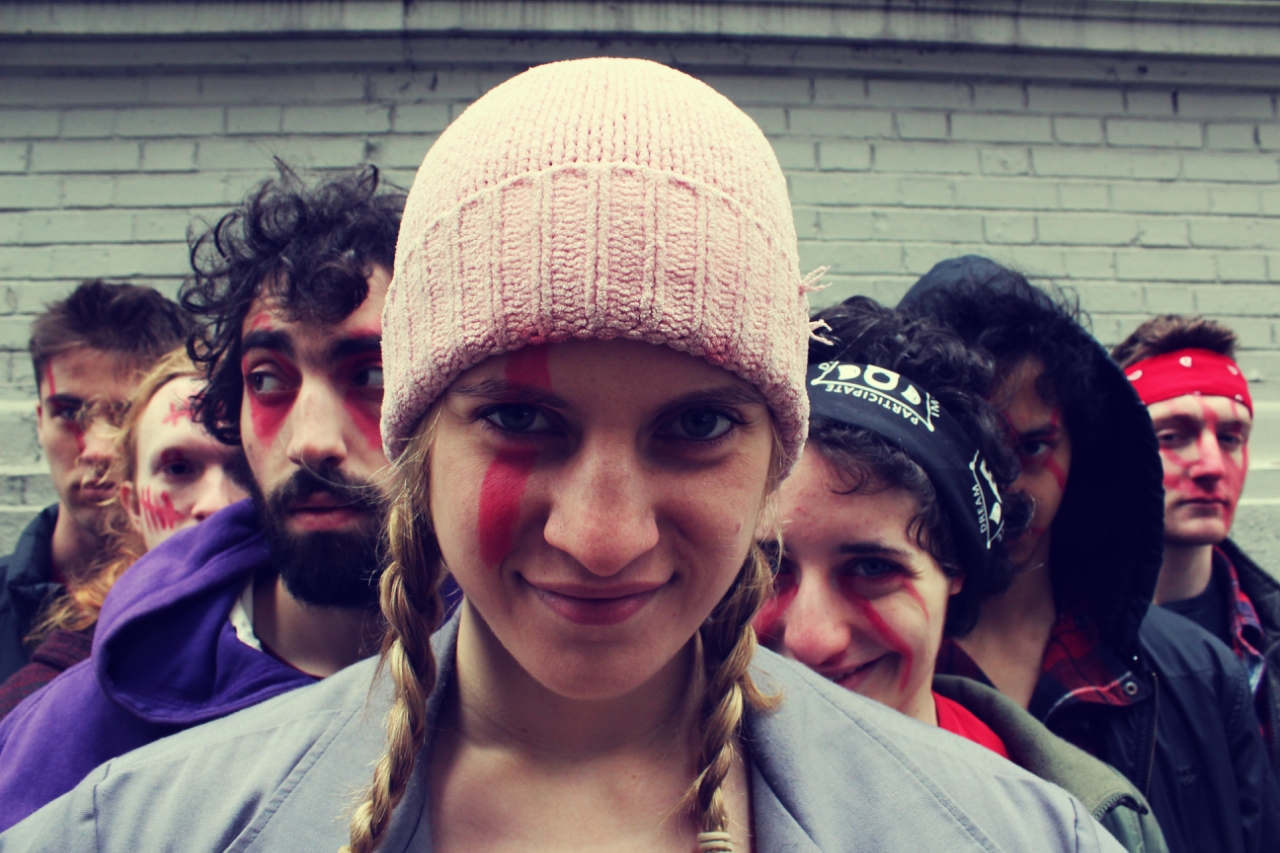
When I got an invitation from Jose Perez IV a few months ago about a new project he was doing involving stage combat, MP3s, and running around the streets of NYC, I didn’t hesitate to RSVP with a resounding HELL YES (Okay, I didn’t exactly say it like that, but the sentiment was there)! For those unfamiliar with Mr. Perez and his ilk (also known as Fight Theatre), they’re the force behind recent Organs of State production Fighter, a high-flying action-adventure about a kid learning his warrior roots and what it truly means to be a fighter (which I had the privilege of seeing back in October). I loved Fighter, and with this new project sounding a lot like a mix between Improv Everywhere‘s MP3 Experiments and Fighter Theater’s aforementioned work, I couldn’t help but get excited at the prospect of witnessing something cool and interactive.
This time around, Perez and Fight Theatre want to take it with you…outside. Sounds serious, huh? Well, it sure is, ’cause the premise behind Snowball Battlefield is that of a team of covert tactical agents called the Blue Team, who are on a mission to stop rival agents — the Red Team, naturally — from not only getting rid of the Winter Season for good, but also making it so that the temperatures don’t drop ALL YEAR ‘ROUND! (While this may seem like a good thing, it may also be wise to add that the Reds want this to happen so that they can turn the world into Baggy-T-Shirt-and-Technicolor-Leggings-Wearing hipsters — oh, the horror!)
Which is where we, the audience, come in — literally. As this is an outdoor MP3 Experiment, those who agreed to come see the show are instructed to download 2 tracks onto their iPods, Zunes (R.I.P.) — and any other mp3 device they may have — prior to meeting up at the starting location on 103rd and Broadway. I have to admit, as I got off the 1 train, I almost panicked, as no one had seemed to gather together at a corner or anything just yet. I caught glimpses of people who looked like they may be part of the show walking around, but was unsure about who was who. It definitely felt like I was summoned by an omniscient agency for a top-secret meeting or hand-over of some sort!
“BLUE TEAM, ACTIVATE!”
The actors eventually did end up convening at a corner, and once everyone was there and we were all properly sync’d up, we were ready to go! The first few minutes had us meeting the members of the Blue Team (Darius Homayoun, Giuseppe Maione, Jenny Carlson, Jack de Sanz and Rose Humphrey), led by Agent 1 (Jose Perez IV), a jaded but talented member of the force who reluctantly becomes their leader…and our hero (yes, that’s a bit dramatic, but just go with it okay). Before we ventured down to the park, we were told the long and sordid history of their rivalry with the Red Team (Alex Romania, Jared Wernick, Jon Garrity, Keiran Mulroy, Melanie Glickman and Sam Ogilvie), whose Evil Ways have contributed to every major disaster in history (including sinking the Titanic, apparently). Luckily for us, we’ve got the Blue Team to help end their tyrannical reign over the weather through this mission.
As Agent 1 leads us on down 103rd, dodging bullets from (invisible) snipers and sword-weilding baddies, eventually parting ways with his teammates. I was amused at the quizzical looks a few passersby threw at us, and while following Agent 1 as he rolled, aimed, and ducked his way down to the Riverside Park entrance, I started to feel a creeping sense of anxiety. Where was the Red Team? I looked up above the buildings where Agent 1 was “aiming” his guns at, but there were no Reddies in sight. Admittedly, this frustrated me, and this led me to wonder where this performance was headed.
The “baddies.”
In terms of geography, the performance itself was obviously, as previously mentioned, headed towards Riverside Park, where Agent 1 reunited with his teammates…and enemies. Yes, the Red Team (comprised of Alex Romania, Jared Wernick, Jon Garrity, Kieran Mulroy, Melody Glickman and Sam Ogilvie) finally pop up, led by leader and Agent 1 nemesis Calamity, also known as Trish (Katie Polin). The Reds eventually reveal the reason behind all their evil-doing, which somehow involves seasonal weather and technicolored tights. From there, the mission hits it’s climax, as the Red Team challenge our guys to an all-out battle in the park — set to some epic music that only we can hear, of course. Ultimately, with clever quick-thinking by Agent 1, the bad guys are duped and the good guys survive — and complete — their mission, saving the day as only one can hope.
Jose Perez’s brand of theater is part experimental performance art and part action-comedy parody. As with Fighter , the choreography seemed at one with the music, making it hard to tell if it was the music that inspired the choreography or vice versa. Either way, it made for effective spectacle, whether or not you had your iPod. An enjoyable send-up of anime, Kung-Fu and action films, Snowball Battlefield felt like going on an adventure with your friends around the city.
___Snowball Battlefield ran on Saturdays from March 10th-31st, 2012 at 103rd & Broadway and Riverside Park. For more information about this production and others like it, click here.
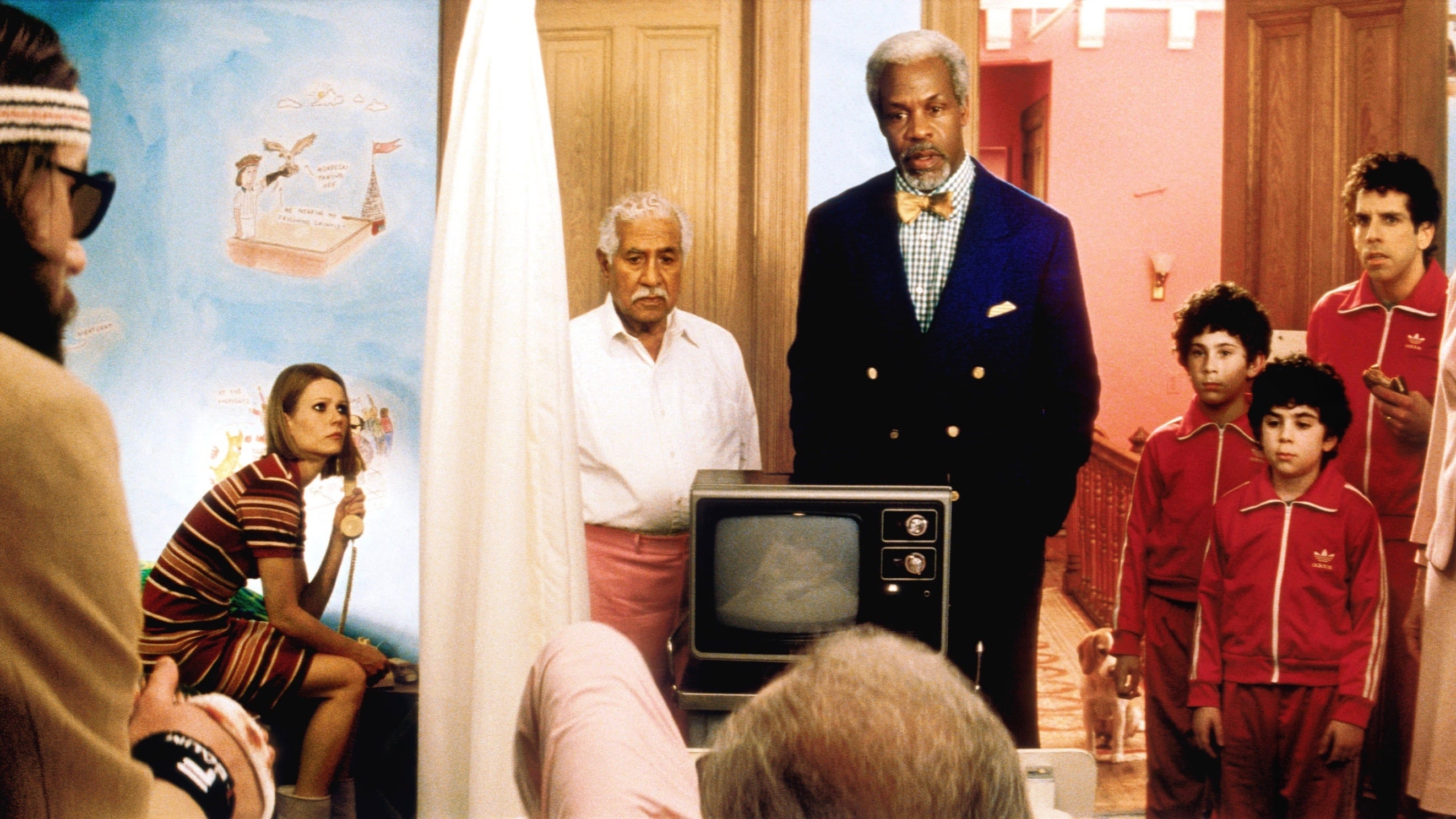
For my Film Theory class this past semester, we were required to see a film at the 49th New York Film Festival and review it―you can only guess how excited I was at this assignment. I had originally planned on seeing Martha Marcy May Marlene, but due to rapid word-of-mouth about Elizabeth Olsen’s performance, tickets were hard to get. I eventually was able to see a film―a special 10th Anniversary screening of The Royal Tenenbaums, with a special introduction by Wes Anderson himself, as well as a Q&A session with members of the cast (Gwyneth Paltrow, Anjelica Huston, and Bill Murray were in attendance) and crew (director Anderson and his brother, who did many of the illustrations seen in the film, as well as many of his other ones).
The following review/analysis is the paper that resulted from that night, which definitely goes down as one of the most memorable experiences of my life. Hope you enjoy it, and if you were in town and caught a film at NYFF49, please feel free to tell me about your experience in the comments, too!
“How old do you think those are?”
“I’d say about 10 years.”
Hearing these words at the New York Film Festival‘s screening of Wes Anderson’s modern classic The Royal Tenenbaums (on October 13th), struck a different chord this time around. The cult favorite, which originally debuted at the festival ten years ago, marked this milestone with a special screening at the place where it all began. The night started out interestingly enough, with yours truly chancing on a single ticket entry in a line filled with either couples or groups. I couldn’t quite believe my chances — so much so that even after I’d paid the NYFF usher, I froze in place, not knowing what to do (even though the most logical thing to do was to, well, go in). The couple in front of me was encouraging enough: “You got into the party―get in there, girl!”
And oh, what a party it was.
Once the Alice Tully Hall auditorium was filled to capacity, the “party” started with the introduction of someone named Ally Tenenbaum, dressed―interestingly enough―very similarly to Ari and Uzi Tenenbaum, complete with curly-top hair and a red Adidas jumpsuit (move over, Sue Sylvester). As a kind of self-professed “lost” Tenenbaum, Ally recounted how the family that “put the ‘fun’ in ‘dysfunctional'” affected her life; which, as she tells it, mostly involved people asking if Anjelica Huston was her mother. She then brought Anderson on to the stage, who said a few things about the film’s history with the festival before the house lights finally dimmed and it was showtime.
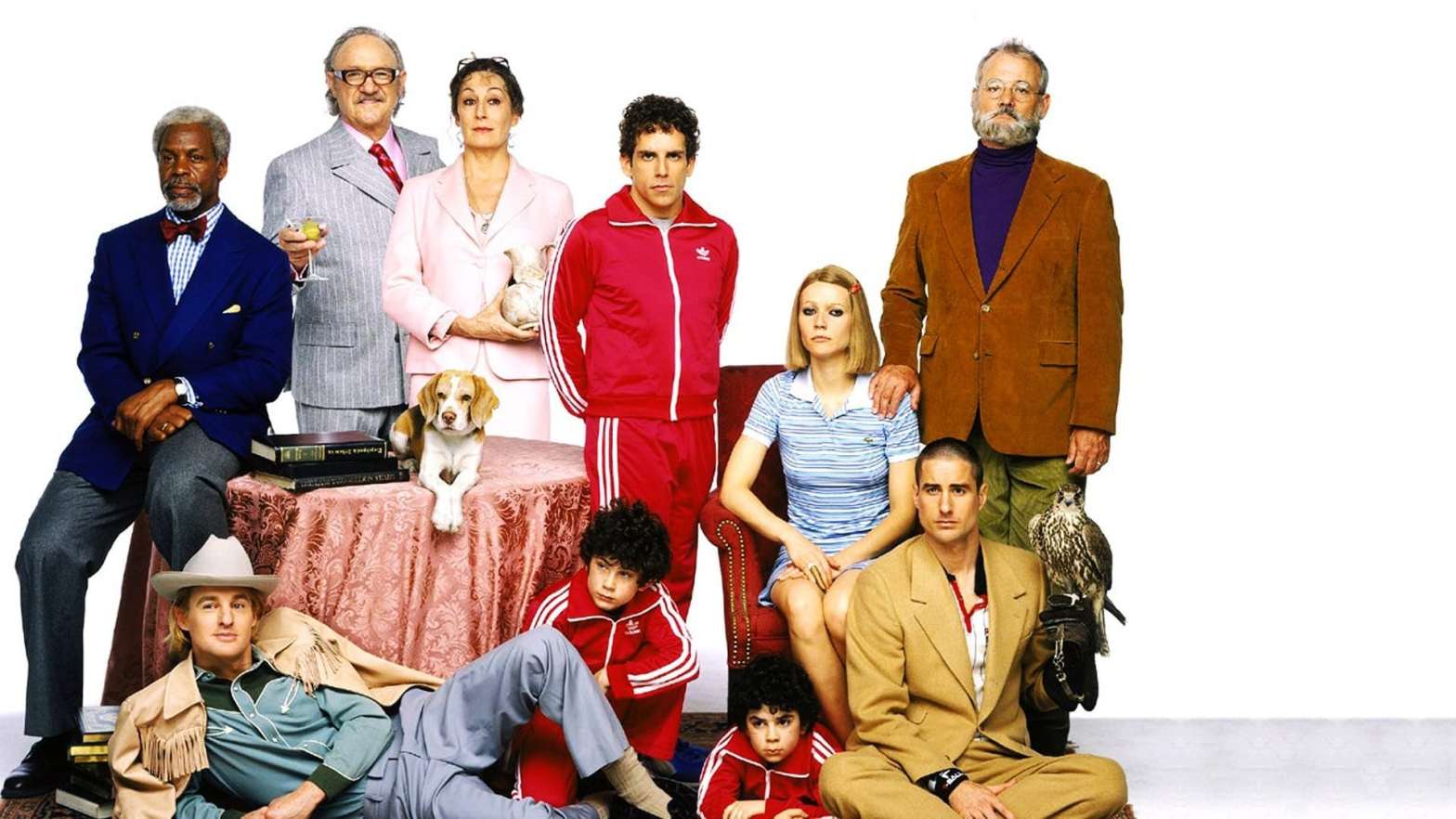
Wes Anderson’s opus, narrated by a gruff-voiced Alec Baldwin, focuses on three scions of renowned litigator, Royal Tenenbaum (Gene Hackman) and archaeologist Etheline (Huston), and the lives they lead in a fantasy New York City in the early 2000s. It starts off with a cold open, as Baldwin’s narration chronicles the early years of the Tenenbaum children, who are widely thought to be geniuses from a young age: there’s financial whiz Chaz (Ben Stiller); tennis champ and dabbling artist Richie (Luke Wilson); and Fulbright Scholar and budding playwright Margot (Gwyneth Paltrow). Rounding out the ensemble are: Owen Wilson, as Richie’s childhood best friend, Margot’s part-time paramour, and aspiring historical novelist Eli Cash; Bill Murray as Margot’s husband, psychologist Raleigh St. Clair; Danny Glover as Etheline’s accountant and bumbling new love interest Howard Sherman; and Kumar Pallana as house servant and Royal’s reluctant partner-in-crime, Pagoda.
As the opening credits fade (to a cover of The Beatles’ “Hey Jude” by Mutato Muzika Orchestra, no less), we jump ahead to the present-day, where we now find the formerly accomplished Tenenbaums living separate lives, all of whom have not seen nearly the same amount of success as they had as children. When Royal, whom upon his separation with Etheline went to live at a hotel, finds out he is bankrupt and on the verge of being evicted, he decides to turn up at his old homestead. However, once Pagoda informs him of Howard’s intentions of marrying Etheline, things really start to get rolling when Royal plots to come back to his family with news that he has contracted a terminal illness. As soon as each of the three Tenenbaum children gets wind of this, they―one-by-one―find themselves thrown back together and living in the same house again after seven years of not speaking.
Throughout the film, the theme of the family reliving the past and being stuck in the glory of their heyday pervades. From a visual perspective, Anderson seems to intentionally―and successfully―weave this particular theme in everything from the usage of the Helvetica font in the credits to the actor’s costumes, to the color palette of the film itself. Many of the characters, as adults, still wear the same clothes: Chaz, with his tracksuit; Richie, with his Izod shirts and sweatbands; Margot with her Izod dresses and signature fur coat. The theme of the past also plays out through the songs chosen for the score, all of which are from the 1970s; some examples include Nico’s “These Days,” The Ramones’ “Judy is a Punk,” and the Peanuts’ “Christmastime is Here” as Margot’s theme. (Indeed, even the choice of Ari and Uzi’s dog, Buckley, as a beagle is Anderson’s self-professed tribute to Snoopy.) Anderson himself has stated that much of his inspiration stemmed from his own experiences growing up in the 1970s, and this is evident in the various references he makes, such as in the case of E.L. Konigsburg’s popular novel, The Mixed-Up Files of Basil E. Frankweiler, wherein two children run away to live at the Metropolitan Museum of Art. (In the film, Richie and Margot spend the night camp out at the National Archives.) Nico also influenced the styling of Margot’s character — her dark eyeliner, as well as the fact that her hair matched her fur coat, was taken from the German Velvet Underground singer’s look.
I have to admit, I did not see the film until earlier this year (I know: shock!), so this was the first time I’ve ever experienced seeing Tenenbaums on a big screen and with an audience. Having never seen any of Anderson’s works beforehand, I can only provide other films I’ve seen, which fall into the same genre, as a basis for comparison. Upon initial viewing, the offbeat vibe immediately called to mind films like I ♥ Huckabees, especially with the whole ’70s look and feel. The Tenenbaums universe takes place, as previously mentioned, in a fictitious New York City where privileged families, such as the eponymous ones in the film, take gypsy cabs and addresses like “100 N. 30th Avenue” exist (which, of course, they don’t). The usage of Green Line buses, which are no longer in use today, are in keeping with the theme.
Tonally speaking, Anderson’s film has a dark comedy feel about it and this is also heavily evident in the writing. Baldwin’s omniscient narration also lends itself a morose overtone, which sets off quite nicely against all the quirky humor laden throughout. Much of the dialogue is humorous without being overly obvious, and this is successfully pulled off with the cast’s often deadpan delivery. Indeed, both films are peppered with witty one-liners which require careful listening in order to truly be appreciated. I was glad that everyone seemed to laugh at all the right parts, especially on the lines I found particularly funny, but personally had felt went over a lot of people’s heads most of the time. For instance, the part when Eli is reading an excerpt from his book out loud, some lines of which are hilarious, there is a part shortly afterward when he says, “Well, everyone knows Custer died at Little Bighorn. What this book presupposes is…maybe he didn’t?” Another part I love that received a big laugh is Young Chaz’s line at Margot’s birthday party early on in the film, referring to a play in which the children played wild animals: “Did you at least think the characters were well developed?” As a theatre lover, it remains among my favorite lines, mainly because of the serious manner in which Aram Aslanian-Persico had delivered it.
The similarities between the two films don’t stop there. By story’s end, all the different characters — each with their own unique set of idiosyncracies―find themselves coming together in a mishmash of events which finally culminate in a “happy” ending. Resolutions are made, and ends are tied. In Tenenbaums, during Howard and Etheline’s nuptuals, Eli―after having been confronted by Richie and Royal about his drug addiction — decides to crash the party, which leads to a car crash and a subsequent chase scene between he and Chaz. In Huckabees, the now-shunned Albert Markovsky (played by Jason Schwartzman, who also previously starred in another Anderson classic, Rushmore) has a confrontation of his own with Jude Law’s Brad Stand, who had taken over his Open Spaces Coalition, which then ends with a silly fight in an elevator. The ridiculousness of both of the climaxes of these films seems to only further add to the humor that is key to the indie dark comedy genre.
After the film, the whole theatre erupted with applause and was met with Anderson and some of the original cast taking their bows in the top right balcony. Shortly thereafter, a Q&A session followed, with two representatives of the NYFF moderating, if a little bit awkwardly so. Anderson himself seemed quite perturbed at some of the questions asked, some of which were admittedly ridiculous (one choice question: “You seem to do a lot of the last scenes in your film in slow motion.” Anderson: “Yeah. What are you asking, exactly?”). Much of the comic relief that helped to dissipate the awkward tension was due, of course, to Murray, who kept up a running joke about Hackman being hard to work with (“He’s weak, he’s just weak.”). Huston and Paltrow, who were also in attendance along with Anderson’s brother (who does much of the artwork seen in his films), also provided some interesting stories from the set. While I wish better questions had been asked, therefore culling more insight from the actors and directors, it was still clear that everyone had a great time making the movie.
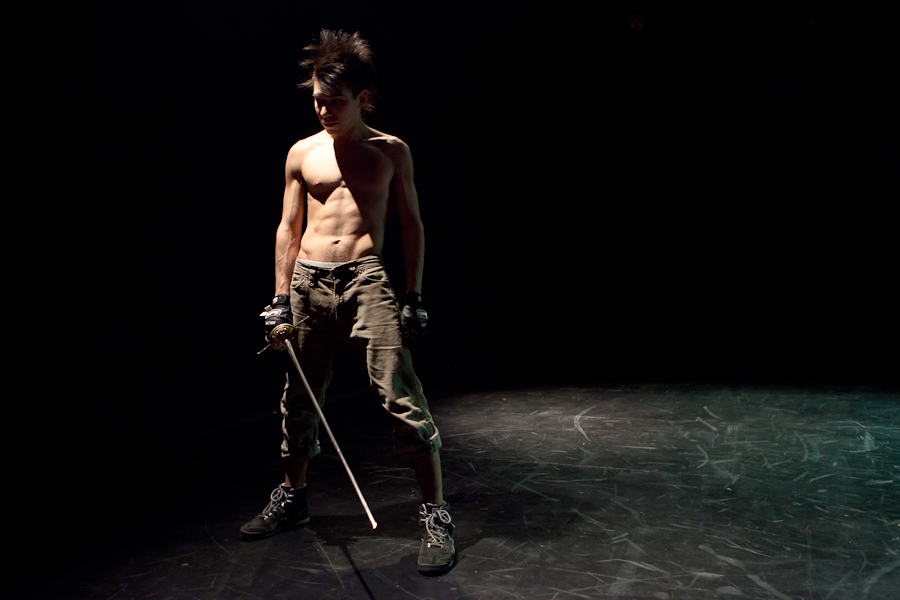
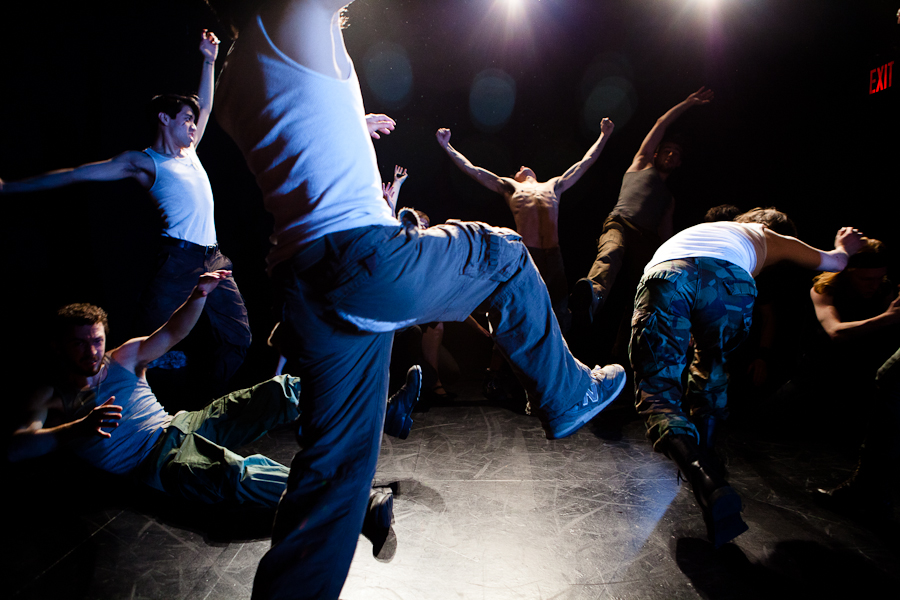
What do you get when you take one part Super Mario Bros., another part Scott Pilgrim, combined with Mortal Kombat, and a little bit of The Last Airbender? You get all kinds of awesome, which is pretty much the only way to sum up the Fighter experience. Written, directed, and choreographed by Jose Perez IV, who also plays Izzy, the show is an epic journey about two guys searching for the true meaning of heroism. Whipping into shape a perfect blend of multimedia technology, martial arts, hip-hop, and some hot ripplin’ abs (um, not that I was looking or anything), Fighter will have you on the edge of your seat, ringside and feeling every trickle of blood, sweat, spit and tears on your face – literally (well, maybe not the blood part — at least, I hope not anyway)!
Stepping into the Shell Theater, located in the Times Square Arts Building, I wasn’t sure what to expect. I certainly didn’t expect there to be an interactive “training session” with the company – sure enough, as soon as the house started to fill up, the audience was treated with the sight of the cast doing various warm-up exercises, their shouts and grunts practically reverberating off the walls. Once the lights dimmed and the show opened to a fight sequence choreographed to The White Stripes’ “7 Nation Army,” it was clear that this would only be a taste of what was to come. As previously mentioned, the play surrounds two best friends, Izzy and Jake (Keenan Joliff), as they attempt to find out more about a warrior legend passed down Izzy’s family for generations, in the hopes they could use it in a presentation about Myths and Legends for their summer school class. Of course, as oral history tends to have the same effect as a childhood game of Telephone, major details were eventually omitted, leaving the two to take a road trip, in the hopes that they would find someone to fill the missing pieces. Along the way, they come across a string of Storytellers, each one providing a new piece to the puzzle.
Each time the boys gain a little more knowledge to The Legend of the Warrior, each stage of the story gets re-enacted in a fight scene, with Izzy taking center stage as the Warrior himself. The “flashback” sequences are presented in a similar fashion to the opening scene, often using rousing, head-pounding music to soundtrack Perez’s (literally) kick-ass choreography. One noteable scene even went so far as to use a remix of “The Bed Intruder Song“, with the cast’s sword-wielding motions timed to perfection with the beat! Any show that can not only pull that off, but pull it off successfully definitely gets my vote. In fact, it was a moment that practically brought a tear to my eye (partially out of laughter and partially because, well, it just really touched me okay guys jeez) and made my meme-obsessed self squee with joy, heart all a-flutter. So bravo to the company, Mr. Perez and Mr. Mitch McCoy (who did the fight direction). Run tell dat.
The show itself as a whole, especially considering the aforementioned scene, was a lot funnier than expected, and surprisingly had a lot of heart, too. What really stood out as a central element to the story was that, at its core, Fighter was not just about what it meant to be your own hero — but what it meant to be a friend, as well. After all, every great superhero needs a sidekick, and Joliff’s Jake provided a great source of comic relief, which in turn added a great balance to Perez’s Izzy, who maintained a quiet intensity throughout. Their chemistry made me believe in their onstage friendship, which was ultimately be put to the test when all their hard work finally culminated in their summer class presentation — where something happens that would not only change their lives forever, but change the audience’s perspective on the story itself, and how it was told. In that vein, Fighter was also about storytelling — how it holds the power to inspire and change people’s lives. Each one of us has a story to tell, and every person we meet along the way affects the way it’s told.
Watching the show, I couldn’t help but think about how “homespun” it felt, as if you were watching 20 of some of your best friends put on a show. This is not to say that the execution fell short at all; on the contrary, everything — from the projections (Euthymios Logothetis) to the lighting (Marika Kent) — was well done, the latter being particularly spot-on during the fight sequences. It reminded me of being 10 years old and seeing my cousins perform at Binghampton University’s Barrio Fiesta nights (organized by student-run Philippine-American League), which consisted of modern and traditional Filipino folk dances, as well as various skits — all written, choreographed and performed by the students themselves. There was definitely an organic, “let’s put on a show, guys!” feel about it that I also felt when watching Fighter. It was certainly refreshing and invigorating to see people around my age up there performing and was a thrill to witness. There was also a sense of instant camaraderie between not just the entire company, but also between themselves and the audience, which brought a unique energy to the show.
Aside from the obvious video game and anime references, Fighter also brought to mind another show I had seen, New York Theatre Workshop’s production of The Seven. Based on Aeschylus’ tale, Seven Against Thebes, about two warring sons of King Oedipus, it also included a combination of epic storytelling, journeys, ancient warriors, hip-hop and anachronistic cultural references. I thought the striking similarities in both shows were quite interesting, and were especially evident in the scenes with the various Storytellers. I loved how each Storyteller had their own distinct personalities, particularly the blind runner, Storytime Steven (Frankie Alicea) and the Not-Quite-Hobo-Enough Storytime Hobo (John Charles Ceccherelli). There were also other standouts in the cast, such as Gabe Green as Running Man, and Andy Zou as Mr. Bootymonster (yes, that’s his name).
All in all, Fighter had me laughing, crying, cheering and jeering — but really, mostly laughing. It’s a show that will make you wish you’d taken that Tae Kwon Do class instead of…oh, I don’t know…7 years of jazz dance. No jazz hands here, it’s all about throwing the punches and doin’ butterfly kicks like a boss when the going gets rough.
Hiiii-YAH!
Images courtesy of Sasha Arutyunova. ‘Fighter’ ran from October 13th-23rd, 2011 at The Shell Theater. For more information about this production, click here. For upcoming productions by Organs of State, click here.
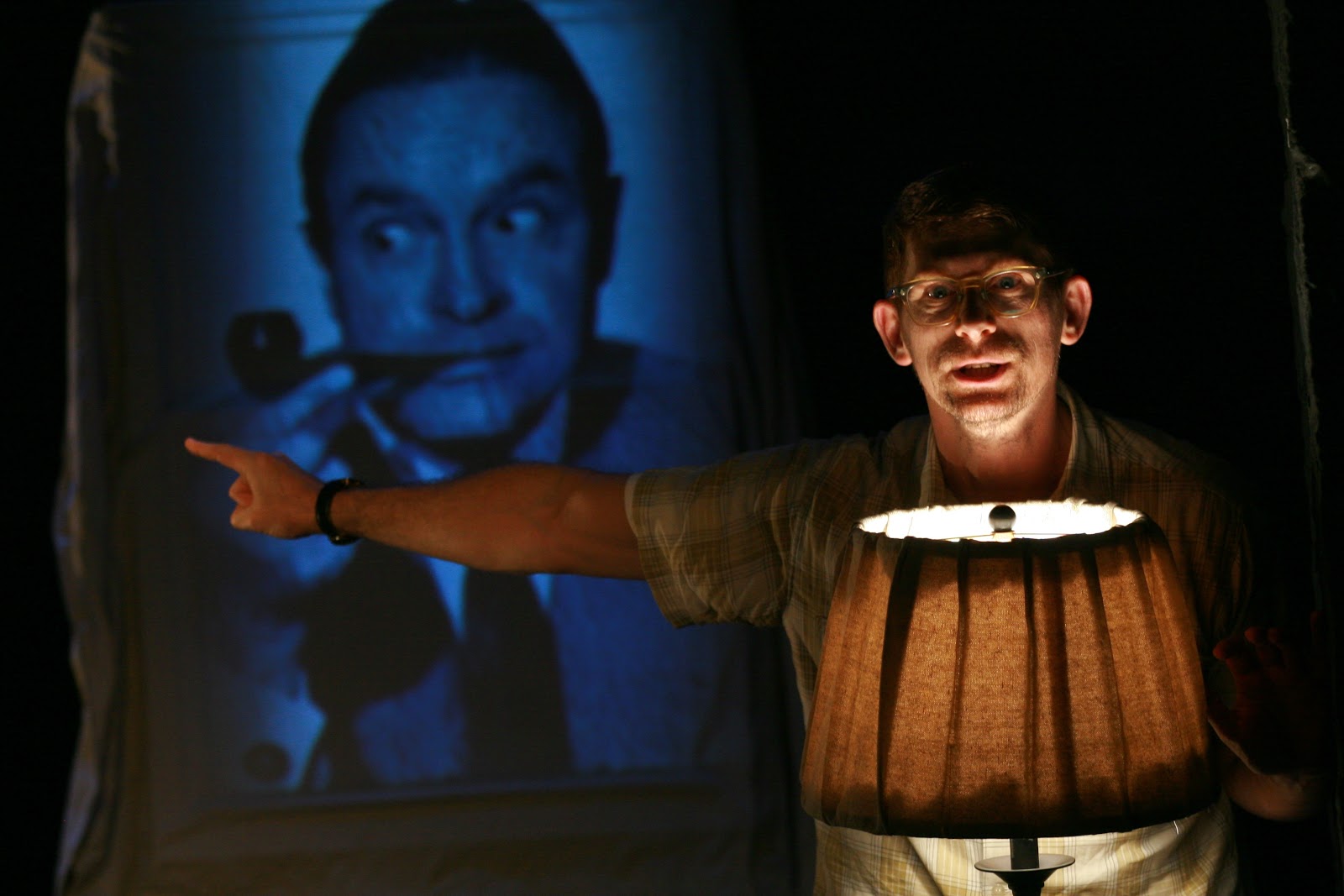
The Adaptations Project’s Founding Artist Donnie Mather, as Allen in “Kaddish.”
Photo by Ben Strothmann.
Allen Ginsberg is considered one of the most important figures of the Beat generation. Originally from Paterson, New Jersey, the poet later moved to New York, a city with which he later became closely associated. He is best known for writing the epic poem Howl, which remains a classic. His poem Kaddish, upon which The Adaptations Project (TAP) based their production, was written three years after the death of his mother, Naomi, who suffered an undiagnosed mental illness. In the Jewish prayer service, the Kaddish, or Mourner’s Kaddish, is often used in funerals and memorials. Ginsberg’s poem takes elements of the prayer, weaving in themes of death and loss.
In this adaptation of Ginsberg’s tribute to his mother, which commemorates the 50th anniversary of its publication, TAP Founding Artist and actor Donnie Mather brings Kaddish — and the poet himself — to life. Here, Mather takes on the piece, staging it as a one-man show. As someone who was not familiar with the source material coming in, watching Mather was interpret Ginsberg’s words was interesting to see. The piece, which runs a good 80 minutes, is almost completely verbatim, faithful to the text except for a few instances where Mather takes on other roles, mostly as Naomi. These role-playing sequences, interspersed throughout, showcase Mather’s abilities to play multiple characters. The performance is set against a minimal setting of three hanging windowsills, upon which visuals are projected. Background noises and sound effects, as well as lighting changes, also come into play, along with a few props.
Truth be told, my past experience with one-man shows — while limited — haven’t exactly converted me into a fan, just yet. The only other such show I’ve seen was Chazz Palmintieri‘s A Bronx Tale, which I’d had some qualms about, and Kaddish was no different. Mainly, I had a problem with the use of sound effects and noises, as well as some of the visuals. Perhaps it is just a case of personal preference, but my idea of one-man shows had always been of just a single performer under the spotlight, telling his story. I suppose these expectations were even more so when I saw that Kaddish was based upon a Ginsberg poem — I somehow had expected it to more of an intimate, poetry slam/reading kind of feel. Of course, this being live theater, it was silly of me to expect it as such, as much as I had tried to come in with an open mind. Still, I would have like to have seen a simpler take, in terms of the staging. I feel as if a lot of the extra stuff, such as the sound effects, distracted from really letting Ginsberg’s words sink in.
That said, there were still things I found enjoyable — some of the projections served as comedic relief in some parts, and also helped to augment the lyrical feeling of Mather’s monologue. Brian H. Scott’s lighting design complemented the performance very well, creating an intimate feel that can only be essential when looking back at Ginsberg’s life and experiences with his mother. And, of course, Mather’s performance, which kept me mesmerized. He has such a presence onstage that no matter who he was playing — Allen, Naomi, or his father, Louis — Mather was able to inhabit each person with such distinctive characteristics that it kept me enthralled.
All in all, it was a very interesting interpretation, and a performance that — even for those not familiar with Allen Ginsberg — will leave the theatre having known a little bit about the voice of a generation…and wanting more.
______
Kaddish ran from September 29th – October 9th, 2011
What do you do when your past comes back to haunt you?
Such is the running theme in this revival of Stephen Belber’s Tape, directed by Sam Helfrich. The play tells the story of two former high school best friends, Jon (Neil Holland) and Vince (Don DiPaolo) discover just that when a ten-year reunion starts to unlock secrets from their past. Jon, an aspiring filmmaker, is in town for the Lansing film festival, where one of his films is screened. He meets with Vince in a Motel 6 where a friendly conversation soon becomes an interrogation.
Niceties are made, jokes are thrown around and memories are shared — particularly that of one night Jon spent with a girl named Amy (Therese Plaehn). Through Belber’s sparse but witty dialogue, we soon learn that Jon had not only dated her, but Vince as well. The conversation starts off innocently enough — Vince asks about the night of a high school friend’s party their senior year, and how far things went between Jon and Amy, both of whom had gotten together shortly after she and Vince had broken up. It is here the conversation takes a dramatic turn, as Vince’s inquiries start to suggest that things had gone too far and reveal his own suspicions of rape. He claims that Amy had confided this to him, an idea that leaves Jon speechless.
Jon’s memories of the night are muddled, and though he was sure at first that nothing happened, he begins to doubt himself. The interrogation reaches new heights when, after much prodding and accusation from Vince, Jon caves in and confesses to the act. At this, Vince takes a tape recorder out from his pocket and replays the conversation.
The question of what to do with the tape hangs in the air, as Vince tells Jon that Amy is coming over, at his invitation. Both are still recovering from the initial shock of Jon’s confession when Amy, now an Assistant District Attorney, makes a revelation of her own: that the supposed rape never happened.
The play toys with the concept of memory; how malleable it is and how it can change over time to suit our needs. What we perceive a certain memory to be is not necessarily what we remember, and Tape not only walks that fine line, but dares to explore it further. For Jon, he started doubting his initial memories fooling around with Amy (as any other pair of teenagers would do at a party) to conceding to Vince’s telling of it being a bit on the rough side. Amy counters this, insisting that the roughest it got was when he covered her mouth during the act. We never really know whether Amy did truly remember or not; whether she was lying just to test the two, or whether it really hadn’t been rape at all.
Both Holland and DiPaolo played off one another very well, and I very much believed them in their roles. Holland seemed to find the right balance of anger, resentment and confusion throughout; DiPaolo’s performance gave so much life to Belber’s often comic dialogue (“I’m not high and mighty. I’m too high to be high and mighty!” comes to mind), and had a great energy that played well against Holland’s Jon. Plaehn also brought an interesting energy to the overall dynamic, and between the three of them, they seemed to really physically inhabit these roles instead of just playing characters — even the silences and beats between lines just felt right with all of them in the room, distant from one another and yet having so much history between them.
Images courtesy of Sal Cacciato.
Tape ran from September 9th – 24th in the June Havoc Theatre at the Abingdon Theatre Arts Complex. For more information on the cast and creatives, go here. Click to vote for it in the New York Innovative Theatre Awards.




 Jessica Taghap