Beauty in the Breakdown: The GIMP Project’s ‘If’

Aerialists Jennifer Bricker and Nate Crawford.
Photo by Chris Ash.

Last weekend, from June 16-18th, La Mama Moves! 2011 presented choreographer Heidi Latsky‘s brave piece entitled, IF.  Composed of three sections — each featuring a quartet, ensemble and duet — IF challenges notions of what it means to be different in today’s society.  The piece is part of an ongoing project, called The GIMP Project, which itself spawned from Latsky’s own experimentations of choreography specifically pertaining to limbs.

The question she kept asking herself as a result of that experience was: what would happen if she choreographed around people who didn’t have any?

IF is the answer to that question.  As Latsky mentioned on numerous occasions at the talkback sessions during the show’s run at La Mama E.T.C.‘s dance festival (which wrapped up its 6th annual year this past Tuesday), the name of The GIMP Project came from the word’s many meanings.  Aside from describing a person with a limp, “gimp” can also be taken to mean, “trembling with ecstasy,” as well as “interwoven fabric.”  IF takes those meanings to a whole new level.  The show opens on a stripped-down, minimalist set — the stage of the Ellen Stewart Theater devoid of curtain legs and the back traveller, baring in its stead nothing but the black marley and a wooden wall exposing a top balcony far behind the stage.  On that top balcony, we see guest artist and La Mama Moves! honoree Joan Finkelstein swaying beautifully under a single spotlight, half obscured in shadow.  Below her, Suleiman Rifai — who is blind — runs his fingers along the wall, also partly visible in a slanted light cast on him from the side.  Standing sentry on balconies on either side of the stage are choreographer Latsky and associate director Jeffrey Freeze.  A pulsing orchestration of strings can be heard throughout this opening section, eventually reaching a crescendo as the dancers cross paths and meet at the wall, with Rifai indeed “trembling with ecstasy” at one point.  As Latsky and Rifai brush against one another along the wall, embracing and then parting, we get the sense that dance communicates more than just a series of movements, but is also a very tactile experience, communicating through feeling.

The ensemble section of the piece starts off equally slowly, with the musical accompaniment replaced by the sounds of steady breathing (recorded, interestingly enough, by someone who had almost drowned).  A row of chairs are set up at the front, and dancers crawl towards them from all directions.  In the back, a woman on rollerblades skates, making figure eights — or rather, infinity signs.  Upstage right, a man in a wheelchair and an African-American woman sit perpendicular to one another, facing away from the audience.  The dancers soon make their way to the chairs, upon which they sit, their hands on chests.  As they close their eyes, breathing along, we see that these dancers are all different.  There is a man with Parkinson’s (Robert Simpson); a woman with a prosthetic leg (Elfie Knecht), among others.  Sitting alongside them are other, seemingly normal, people.  Whether they are disabled or not, we do not see.  However, by the time they start to move and sway their arms, grazing the air and each other, we realize that it does not matter.  They are all the same.  We are all the same.

That concept is never more clear than when the line of chairs are broken and fall into a V-formation, the music accompaniment changing yet again from breathing to another arrangement of strings.  At each of their stations, each dancer poses in “snapshots,” with the middle row broken into pairs and performing a set of duets.  These duets are later described by Latsky as “conversations,” and along with the snapshots, continuing to communicate the idea that being different doesn’t mean we aren’t the same.  However separate our lives may be, however many different walks of life we come from, our stories run along the same fabric, interwoven.  The dancers break down into a series of choreography in unison and together, they are beautiful.  Strung together, hearts pulsing as one, meeting and then parting.

One by one, members of the ensemble leave the stage as aeralists Nate Crawford and Jennifer Bricker enter, and a red silk is lowered down.  While the two mount the silk, wrapping themselves up in it as if in a cocoon, we hear once again the rhythmic breathing in the background, almost acting as a metronome against the red silk we see swinging back and forth like a pendulum.  A heartbeat, a muscle.  The duo continue, performing a series of moves that can only leave one stunned and awe-inspired.  A beautiful picture of ability and disability becoming one and yet, cancelling one another out.  As the lights fade on the image of Crawford spinning sideways atop the silk, with the twisted end unraveling, you realize that it was never just one or the other.  It doesn’t have to be.

IF is no doubt an important piece, but more than that, it is a movement, a conversation-starter about something that isn’t always talked about.  Handicaps — whether visible or invisible, whether physical or emotional, is something that we all share and something we can all relate to.  Despite all of our so-called “disabilities,” IF is all about — as Latsky says — “displaying each person’s virtuosities.”  Indeed, the GIMP Project and its performers certainly achieved that.

La MaMa presents The GIMP Project: “If” from La MaMa on Vimeo.

Learn more about The GIMP Project and where they’re performing IF next.

A Conversation with…THE ORANGE HATS’ Benjamin Lundberg

Ben Lundberg talks about wearing that famous hat.
_____________________________

I first met Ben Lundberg and his colleague (and Culture Future blogger) Guy Yedwab at the Theater Tweetup back in March, which some of you may remember reading about.  It was there they first told me about their project called The Orange Hats, which archived audience response to live performance. 
This intrigued me, being someone who is also steeped in audience response, albeit from a different point of view.  This led me to meet up with Lundberg once again, and about a month ago, we sat down for an interview.  
Here, Lundberg talks about “origins, current happenings and archiving.” 
_____________________________

Beginnings.  The Orange Hats have come a long way since their inception back in the summer of 2009.  Around that time, the Grahamstown National Arts Festival was taking place in Johannesburg, South Africa, where Lundberg was studying abroad.  The festival,  Lundberg explained, is comprised of a Fringe festival and the Main festival.  A s with many festivals around the world, a lot of the shows’ successes or failures ride on just 50 words or so of critics who attend marathon viewings — in Grahamstown’s case, undergraduate journalism students.  The fact that weeks of artists’ hard work depended on being judged in this context struck Lundberg as wrong, and a conversation with friend and colleague Megan Godsell about what he called the “critical culture” sparked an idea for a vehicle that would provide a different kind of critical response.

Under the support of the National Arts Festival, they put their plan into action that June and July.  After the Festival ended, The Orange Hats moved onto the University of the Witswatersrand that August, which was where Lundberg happened to be studying.  Some of the project’s earlier work that first summer started off as experimental, with participants writing personal responses and even “in character” responses.  By the time Lundberg came back to New York City, he started archiving on his own before taking on Guy Yedwab as a fellow Orange Hatter in August 2010.    

Mission The Orange Hats, so-called because of the brightly colored headgear used as the group’s signifiers, aim to archive audience responses.  “What it’s really about, “said Lundberg, “is saying that real conversations happen after performances that are never documented.”


Thanks to Lundberg’s project, much post-show dialogue has been documented, with the group inserting their own take whilst also keeping it at arm’s length for the viewer.  The intention always to make the viewer think, giving a well-rounded take on what the audience experienced.  The Orange Hats’ videos also try to cater to the aesthetic of each show it covers, whether by the music playing in the background (such as their American Idiot video), or by graphics (NYU Tisch’s Fighter).
 

It’s more about: how can we perform criticism or perform a discussion?  What is a performative way of transmitting conversation to a wider audience?  That’s what the project was about.


Audience.  When it comes to what he has learned about audiences as a “silent observer,” Lundberg noted that a few things that struck him.  He found that the older the audience, the harder it was to archive.  “People of a certain generation are not as comfortable being on camera,” he said.  Of the ones that do, tended to range from “parental” responses (“Oh, everyone did a great job!”) to those that were more honest and unabashed.


As far as larger experiential observations, Lundberg noted: “I don’t think I would have become as interested in this project if I wasn’t inherently somebody who engaged in criticism a lot.”  Because of the fact that he archives others’ responses immediately after a performance, Lundberg does not get to engage with his own feelings.  “What’s interesting,” he said, “is that it gives me at least twenty minutes of pause where I’m not obsessed with what I think about a show, where that’s not my main focus.  I have to listen to [others’ responses], because we ask questions…because we’re trying to open a conversation, so I really have to be part of that conversation, even though I’m a silent part.”   

Branching out.   As of October 2010, The Orange Hats expanded their project to Lundberg’s alma mater, New York University‘s Tisch School of the Arts.  Initially, he sent a letter to Tisch’s Undergraduate Student Council, starting the branch as a club.  The Orange Hats: Tisch would archive undergraduate performances at the school.  The group would also act as an incubator for members during their 4-year stay at the school, serving as both a mentoring and teaching program, “in which students get to see a lot of theatre and ask questions about audiences and arts criticism.”

_______________________________

See more archives here, &
Follow The Orange Hats on Twitter to find out what they’re #orangehatting next!


A Mad World: The United States Theatre Project’s ‘columbinus’ Goes Inside the Typical All-American High School — And Tears it Apart

This past weekend’s viewing of A Shot Away had me reminiscing about other docudramas I’ve enjoyed over the years.  Jonathan Mandell noted how Red Fern’s production had reminded him of Jessica Blank and Erik Jensen’s The Exonerated, and I definitely agree; it had a lot of the same elements, including a lot of quote-worthy dialogue.  One other play that ASA had reminded me of was columbinus, a daring docudrama produced by The United States Theatre Project, in conjunction with New York Theatre Workshop.  

I often say that this was one of the plays that changed my life.  I had seen it with my AP English class my senior year of high school.  It was our last school trip as high schoolers, as well as our teacher, Mr. C.’s last as a high school teacher.  Mr. C. had always encouraged a love of the theatre in his students, bringing us out to the off-Broadway world and having legendary artists like Julian Beck and Judith Malina of The Living Theatre into the classroom.  For extra credit, he gave us an assignment where we had to review the play we had just seen.  The result is below — needless to say, I think I did very well!

Seeing columbinus changed how I thought about how theatre was performed and presented.  I realized that it wasn’t just merely another medium used to entertain, but that it provided a forum for social commentary.  It also further cemented the feeling that I had of theatre being a community that I wanted to be a part of, and still hope to be a part of now.  

So without further ado, here’s the review that started it all.


Imagine you’re walking down a hall full of kids: of artists and jocks, of drama geeks and “gangstas,” of dreamers and slackers alike.  Each kid pushing and shoving, trying to make their way through the mad world of high school — or at least just the halls, anyway.  It seems like it’s just another ordinary day at school…except that it’s not.  Despite the proclamation inscripted on the walls, stating: Through these halls pass the finest kids in America, above all the pushing and shoving you hear a gunshot.  In that instant, everything you ever thought or known about high school has completely changed. 

Such is the impact that is made upon viewing a performance of columbinus, a courageous piece based on the 1999 Columbine High School shootings in Littleton, Colorado.  In the play, the first act starts off depicting various familiar archetypes that would haunt any high school in middle America.  In the scene entitled “Selection,” the message that the persona you fit into is something that you purposely choose upon entering high school is shown through each character literally choosing single identifying props for their archetype.  There was a makeup compact for the popular blonde; cigarettes for the rebellious misfit, who also happened to be the drama geek; a hat for the jock; glasses for the nerd, etc.  With Gary Jules’ song, “Mad World” playing in the background, a song so eerily familiar to those who’ve seen the cult classic Donnie Darko, the scene certainly captures high school at its most real. 

And it’s a mad world, indeed.

What pleasantly surprised me was the added depth to each of these everyday figures — they’re not as one-dimensional as we all think them to be.  In one scene, in which The Verve’s “Bittersweet Symphony” (also heard on another cult film, Cruel Intentions) propels a montage-like exploration into each character’s fears and weaknesses through individual spotlights.  We see the same misfit cutting herself, the popular blonde finding out she’s pregnant, and the resident religious girl having a crisis of faith.  As all of these characters line up on the edge of the stage, lip-synching to the song, we come to realize that theses are real people after all, hindered by their choice because they have no choice.

However, the play also starts off focusing on what we see as the everyday norm: the endless taunting and clique rivalries echo through the halls and in our minds.  From little incidents, such as ketchup packets being thrown at the “freaks,” to the isolation felt in the locker rooms, we see the familiar side of high school — its facade — and in it, we two teenagers living on the other side of the jeering, Dylan Klebold and Eric Harris.  These two, of course,  are based on the actual mass murder duo also known as the “Trenchcoat Mafia.”  Decked out in cargo pants and military boots, along with their signature trenchcoats, both Klebold and Harris were seen as “different” — and for that, everyone had to pay the price.  Sick of having to endure the looks and the whispers day after day, Dylan and Eric start to devise a plan.

In the second act, the production portrayed a play-by-play of the events of April 20, 1999 — complete with documented recordings of 911 calls, as well as transcripts from conducted interviews with victims and actual images of the Mafia from surveillance feeds.  This portion of the production would certainly raise questions by the general public concerning possible exploitation of the victims and glorification of the murderers; how does one reenact a high school shooting?  Despite the questions raised, under P.J. Paparelli’s brilliant direction, raging violence was not on display here, but rather the poignant performances and unique talent of the entire columbinus company.  No longer in their stereotypical teenage garb, Anna Camp, Carmen Hurlihy, Nicole Lowrance, Joaquin Perez-Campbell and others recited actual accounts of the massacre in the library.  Here, they were not just “victims,” but people with strength and dignity, even in the face of a gun.

On that fateful April day, most of the 13 students who perished during the killing spree had been situated in the library.  Upon viewing Paparelli’s staged version of the library massacre, I was glad to see that the murderers were not given their heyday onstage.  Instead, they were left in the background while the rest of the company was at the forefront, making sure that the stories of the lives taken that day were heard over the sounds of “gunshots,” caused by the two villains banging  on the back wall.  This would come to symbolize memories begging to be heard over the deafening sounds trying to silence them into the ground.  For certain moments when victims were met with a gun, it had been staged so that the killers did not directly face them.

While I had been thoroughly impressed with the cast members playing the victims, I had been equally enthralled by the performances of both Will Rogers and Karl Miller, who played Klebold and Harris, respectively.  Throughout the production, I felt that these two had captured the essence of what it’s like as a disenfranchised youth in America today.  I felt Miller’s performance, particularly, to be intense, yet slightly vulnerable at the same time.  As for Rogers, I found him to be a great source of comedic relief during the “Instant Message” scene, as well as equally unwavering in his performance towards the end.  

All in all, columbinus is a surprisingly poignant, thought-provoking look at high school life and the ways it can manifest into something as self- (and mass-) destructive as a shooting.  You leave the theatre wondering how such an atrocity could happen in an adult-supervised world like high school.  Questions plague your mind and you suddenly reevaluate everything, because you realize that the people you just saw onstage reflect people you see everyday in the halls.  They’re the same people you wave hello to, cheat off of in science class,  or just plain ignore.  

Most importantly, you ask yourself one question above all others: Why? 


Images courtesy of New York Theatre Workshop. columbinus ran from May 5 – June 11, 2006 at the New York Theatre Workshop.

An Argument for Consciousness: Red Fern Theatre’s ‘A Shot Away’ Gives a Voice to Those Silenced

Photo by Brittany Duck

“The Few, The Proud.” “Be All that You Can Be.”  These are just some of the ways the military uses to attract the many that enlist each year.  However, beneath the handsome and dutiful men in uniform shown on television and moviehouse screens lies a darker side of the military that is never shown and almost never talked about: rape and sexual assault.  Red Fern Theatre Company, an institution that strives to bring about change through powerful commentary in the shows they produce, explores these issues in Donna Fiumano-Farley‘s A Shot Away.  With six different characters representing their real-life counterparts, whom the playwright interviewed during the four years of dramaturgical research prior to production, the play takes the words of the victims and sets them onstage.  Against these six individual stories is the story of Tina Priest, an Army Private whose death yielded suspicious circumstances and is survived by her mother and twin sister.
 
Before the play has even started, the audience is greeted with Lee Greenwood’s “God Bless the USA,” with the words “I’m proud to be an American” sung in jubilant repetition, juxtaposed against Katherine Akiko Day‘s dark and minimalist scenic design.  In the 14th Street Y‘s small black box theatre, by the back wall, we see a huge backdrop of an American flag; in the forefront, a “porch-like” setting, complete with a coffee table and wicker chairs.  Just then, a single spotlight turns on, and we see Joy Priest (Jackie Sanders), Tina’s mother, telling her daughter’s story through the diaries and knick-knacks she left behind.  Soon enough, Priest’s story is interrupted by the stories of six others, whose silhouettes behind the backdrop soon reveal the following characters: Panayiota (Laura Anderson), a young Asian-American woman; KC (brilliantly enacted by Dana Berger), a tomboy; Amando (Grant Chang), a Filipino man; Shirley (Elizabeth Flax), a middle-aged Black woman; Marianne (Jessica Myhr), a self-professed “girly-girl,” and Michael (Jeff Pierce), a seemingly all-American man’s man.
While each of their characters are completely different, their stories start off on the same positive note, describing their initial interest in joining the military forces.  KC, drunk with her friends at a bar, impulsively decides they all enlist together and in the end, turns out to be the only one who went through with it.  Amando has always wanted to serve, but with no opportunity was there for him in his native Philippines, he comes to America and enlists.  For Tina Priest, it came as a surprise for her loved ones that she would join, as she “loved life.”  Her story, which is told sporadically throughout, then turns from the portrait of a girl set on living a quiet military life in Fort Hood to having her life turn topsy-turvy as she is sent to Iraq.
 
Information of each characters’ experiences is given to us little by little, one by one.  Seemingly friendly first encounters with men of higher rank are described, and slowly we learn how these situations happen.  They are stories we all heard before, but never in the context of the military, they are haunting.  It is here where Sanders really shines as Priest’s mother, as well as Tara Ricasa as twin sister, Danielle.  The mother and daughter narrate Priest’s experience in passionate detail, especially when it comes to the circumstances surrounding her sudden death. Her death was never fully investigated, instead listed as a suicide.  The rest of the characters continue telling their stories: many of them staying silent about what they went through because of death threats or sense of pride (in the mens’ case), while others sought help, but never got any.  We hear the numbers, the statistics — they are astounding.  According to the show’s program: in 2007, there was a total of 2,688 reports involving military sexual assault.  80 percent of those are never reported, which puts the number over a staggering 13,000 cases. 
 
With a stellar cast and strong dramatic narrative, A Shot Away is both informative and relevant, now more than ever.  In a country involved in two wars, we need to be sure that our men and women feel safe with their fellow soldiers.  This piece comes shortly after a lawsuit was filed this past February against Defense Secretary Robert Gates and predecessor Donald Rumsfeld by seventeen former and active-duty members, alleging that not enough was done to stop and prevent rapes, as well as investigate crimes such as Tina Priest’s death.  Panayiota Bertzikis, shortly after her time in the military, started the Military Rape Crisis Center, with whom RFTC has partnered during the run of this production.


Those who know anyone in the military, or anyone who has been sexually assaulted, definitely should see this show.  For more information on the Military Rape Crisis Center, go here.
  

Let’s Pick up the Pace and Go to Hell in a Fast Car: Kander & Ebb’s Chicago Serves Up Some ‘Razzle Dazzle’

Imagine this: a steamy jazz club.  A saxophone whining and groaning into the smoky air.  Dancers in their racy costumes, warming up.  All of a sudden, the song segues into a rag-tag big band number, and under a single spotlight stands headliner Velma Kelly in a rendition of a familiar song.  Well, stop dreaming, because re-living the Roarin’ Twenties has come to life in the form of the acclaimed Kander and Ebb musical, Chicago.  Rife with choreography by legend Bob Fosse, Chicago is a mix of laughs, greed, and sex.

The story surrounds the case of Roxanne “Roxie” Hart, a wannabe vaudeville star charged with the crime of killing her lover, Fred Casely, with whom she’d been having an affair.  The renowned musical is a satire that takes hits on politics, the law, and the impact of the media; it also reflects a time of liberation amongst women, in which they were starting to recognize their sexuality and the power they possess over men.

The first act starts out with “All That Jazz”, the popular number that gave Bebe Neuwirth a Tony in the 1997 revival.  It is here where my fascination with Fosse-esque choreography is refreshed.  Much different than that of Rob Marshall’s in his Ocscar-winning 2002 screen adaptation, Fosse’s choreography is notoriously precise and abstract, and this particular performance is a prime example of why Bob Fosse is a legend.  For the current production, Ann Reinking – who’d starred opposite Neuwirth as Roxie Hart – updates Fosse’s moves, serving as the revival’s choreographer, which is beautifully captured and stylized throughout the evening’s show.  Some choreography, however, disappointed me, most specifically in the “I Can’t Do it Alone” segment, which is one of my favorite songs and parts from the movie.  Onstage, however, it had been choreographed with more child-like motions, to bring out the fact that Velma was indeed talented.  One supposes, however, that perhaps the campy aspects of numbers such as these were to receive laughs, which is considerably the main objective of the show’s concept; we are to laugh at the seriousness these characters take into wanting to be in the spotlight.

As the first act wears on, the cell block girls – consisting of Liz (Michelle M. Robinson), Annie (Gabriela Garcia), June (Sharon Moore), The Hunyak (Emily Fletcher), and Mona (Robyn Hurder) – give their rendition of the “Cell Block Tango”, which remains a popular favorite among audiences who have seen the film.  Here, one may start to notice the show’s minimalist set design, as there are no cell bars, unlike those seen in the movie.  Instead, each girl is given their own chair from which to regale the audience with their respective monologues, which still receive laughs.

The stage setting gave one that intimate feeling, as if the whole story was unfolding before us in a tiny jazz club during that era.  The orchestra sat onstage, in plain view, which brings to mind a heavy Brechtian influence.  Various characters, including at times the conductor of the orchestra, announce the entrance of the characters as a new number began – much as if a bandleader would announce acts in a club.

Another Brecht reference of note had been the absence of a Fourth Wall.  Throughout the production, many actors talk to the audience; the characters Roxie and Velma demonstrate this the most.  In the numbers “Roxie” and “I Know a Girl”, both of the respective characters rely on the audience’s participation.  This is further demonstrated later when Velma asks for her “exit music”, breaking out of character.

The show was not without its eye candy, either; Towards the second act, in “Razzle Dazzle”, the character Billy Flynn sings about distracting onlookers so that they won’t detect a farce, and with the dancers doing cirque-inspired moves, it had definitely been a sight to see.  Sequins at the end of the number also added to the feeling that one had traveled back to the glamour of the twenties.  By the time the “Nowadays” reprise came around, in which Roxie and Velma had joined forces, a glittering gold and silver background provided the high-energy atmosphere, as if we really had arrived at the Chicago Theater.

The cast itself yielded a plethora of multi-talented performers, all of whom simultaneously sang, danced, and acted.  The portrayal of each character revealed new dimensions that otherwise hadn’t been explored through different medium, such as Marshall’s film.  Played to comedic perfection by Bianca Marroquin, I felt that the stage version of Roxie, as opposed to Renee Zellweger’s screen interpretation, made her seem more street smart yet naïve, rather than just ditzy, as had been portrayed in the film.  In numbers such as ”Razzle Dazzle” and “Me and my Baby”, Marroquin’s performance had provided much of the comedic relief.  The trial scene, especially, had been where I found myself laughing the most, as the actors re-told the happenings of Roxie’s crime in a skewed way, and in the process emphasized Ms. Marroquin’s comedic chops.

The other star in the musical is the character Velma Kelly, played by Donna Marie Asbury.  Velma, a washed-up true vaudevillian lounge singer who’d murdered her sister and husband – after having found them in the kip together, no less – is more of a sarcastic and cynical character compared to Roxie.  However, Ms. Asbury was not without her share of funny bits, either – she proved worthy of the stage in songs such as “My Own Best Friend”, “I Can’t Do it Alone”, and “Class”.   

One number, however, that had the audience entranced, had been Roz Ryan’s performance of “When You’re Good to Mama”, as the Matron “Mama” Morton.  Ms. Ryan was a joy to watch, her powerhouse voice mesmerizing as she flirted with the audience, asking a viewer in the front row: “You like that, don’t you, baby?”  She fit the role to a T and was formidable against Donna Marie Asbury’s Velma Kelly.  I felt that Ms. Ryan and Ms. Asbury really had that certain chemistry in which they were playing off each other with great ease, which was evident when they dueted in “Class”.

Upon her entrance into the local jailhouse, Roxie’s case is soon picked up by notorious lawyer Billy Flynn.  With Flynn by her side, Roxie learns to manipulate the media and eventually ends up winning the trial.   By the time Bernard Dotson emerged as Flynn, the show was rolling.  Dotson’s portrayal as Flynn proved at once charming and comedic.  The height of his performance, I felt, occurred later in the second act, during the number “Razzle Dazzle”.

Rob Bartlett, who plays the character Amos Hart, Roxie’s devoted but stagnant husband, was another pleasing surprise.  Known mostly as a commentator on the Imus in the Morning radio show, Bartlett stole the stage (and garnered a few “aw’s” from the audience as well) in the number “Mister Cellophane”.  In the song, his character sings of being constantly ignored by everyone; however, this had the converse effect, as his performance gave us even more reason to keep watching out for him.

Another principal actor, R. Lowe, set a different whirl of emotion amongst audience members: that of confusion and intrigue.  It takes a certain kind of woman to play Marie Sunshine, the gullible yet revered newspaper reporter, and R. Lowe’s outstanding performance proves it.  As Mary Sunshine is introduced to us in the number “A Little Bit of Good”, it seems clear to everyone that things were not as they seemed.  Indeed, by the trial scene, it is revealed that Mary Sunshine is really –

Well, that’s a whole other story entirely.  In any case, if you love deception, greed and murder combined with comedy, as well as song and dance, then you will love Chicago.  So step back into a time of jazz and liquor, where you could become famous in an instant.  After all, there’s no other place that’ll let you get away with murder—that, indeed, is Chicago!


Images courtesy of Jeremy Daniel and ibdb.com. Chicago opened on November 14, 1996 and is currently running at the Ambassador Theatre (219 West 49th Street).

The Death (and Life) of American Theatre Criticism

In continuation of many retrospective blogposts (which include this one), I want to start off my saying that lately, I have been re-assessing my love (and place) in the theatre — mainly, where criticism is concerned. This past year has given me both positives, as well as negatives, and it was those negative times that made me question whether criticism was right for me. I am now in a more positive place, and see that, of course, I still do want to be a theatre critic.

Luckily for me, I realized this when, amongst old reviews I’d done for my Intro to Theatre class, I stumbled upon an oral essay by theater critic — and my former World Theatre professor — Jonathan Kalb. He’d given a copy to me when I’d professed my ambitions, and the essay — which was originally lectured to students at Barnard College and New York University in the Fall of 2002 — was meant as a piece of advice to young, aspiring critics like myself. So for those looking to go into the field, I’ve included some worthy snippets of that lecture here, and hope you feel inspired, too.

The Death (and Life) of American Theater Criticism: Advice to the Young Critic

by Jonathan Kalb

CREATE YOUR OWN REALITY.

Our culture holds only one value more dear than money and youth: self-invention. Don’t waste time waiting for any established critic to drop dead so you can slip into the vacancy. Chances are, there will never be a vacancy because the publication will bury the theater column with the critic. Or else it will hire the editor’s brother-in-law from Topeka. Very few editors today can make distinctions between good and bad theater criticism; they need you to stick their noses in the plate.

CONVEY WHY THE THEATER IS IMPORTANT.

Since the standard assumption today is that it isn’t, everyone who disagrees has a shining chance to surprise people. Bear in mind, however, that most readers don’t care nearly as much as you do, to begin with, about the difference between, say, the “liveliness” of TV and the “liveliness” of theater. This is where having an original artistic sensibility becomes crucial. If your critical writing doesn’t swell with articulate enthusiasm for what is indispensable about a certain kind of theater, then it stands no chance of seeming indispensable itself.

Any art so vulnerable that it needs euphemized reviews to survive ought to be put out of its misery, just as any country that needs to outlaw flag-burning ought to think again about what loyalty means. The bigger question is, as John Donatich , the publisher of Basic Books, recently put it: “How do we battle the gravitation toward happy consensus that paralyzes our national debate?” Or again Wilde says it well: “A critic cannot be fair in the ordinary sense of the word. It is only about things that do not interest one that one can give a really unbiased opinion, which is no doubt the reason why an unbiased opinion is always absolutely valueless.”

STRETCH THE ENVELOPE. GRASP THE APPARATUS.

One needn’t be a revolutionary. Even small gestures like broaching a subject beyond the crimped purview of pop culture, or clearly explaining an unfamiliar or slightly complex idea, can stretch the envelope noticeably. I see criticism as a form of resistance in an age when the agents of power (big media and politicians) have co-opted the language of rebellion to the point where counterrebellion is often indistinguishable from rebellion. There is a tiny but tremendously important opportunity in the fact that some arts — theater, dance, poetry — aren’t usually considered worthy of commodification by the mass media, and my work tries to wedge that window open. Utopian ardor doesn’t make me any paragon of honesty, of course. Often enough, I get my fingers jammed in the sash or grow infuriated when there’s nothing but cotton candy outside the window for weeks on end, and then I’m as capable of venom and compromise as everyone else.

GIVE UP THE GOAL OF POWER.

You can’t avoid having power as a critic, but you should give it up as a goal. The sooner you do this, the happier you’ll be. For most people, theater criticism isn’t a profession, it’s a calling, and the long-term satisfaction is in moving minds, not tickets. The fact that most of the approbation and opprobrium that one is subject to as a critic has to do with the movement of tickets can be distracting and confusing, but you must never take that personally. Both the praise and the blame are about advertising, not art or ideas. In any case, producers and publicists today know perfectly well that unfavorable reviews are far better than no reviews. In fact, they’re often as good as favorable ones because so many people don’t really read but rather skim headers and headlines on the way to the listings and personal ads. Simply getting an event covered is the real PR coup nowadays, even in the anxiety-producing New York Times. I mention all this to lift a potential burden off you before it ever settles in.

As Richard Gilman once said succinctly: “The critic cannot give his loyalty to men and institutions since he owes to it something a great deal more permanent. He owes it, of course, to truth and to dramatic art.”

WRITE JOURNALISM. READ BEYOND IT.

Journalistic criticism is bridge-building — bringing unfamiliar ideas to a general audience, connecting demanding art to a reluctant public, reaching across the borders of established institutions, professions, and disciplines. No one can cross a bridge that isn’t anchored securely on both banks, however. The world has quite enough academics who don’t write lucidly enough to hold a general audience, thank you very much, and quite enough journalists who don’t know enough to offer anything but stagnant opinions. The rarity are those in the middle — real ambassadors who can play to both sides. So sharpen your writing, work on it at every opportunity, but also keep yourself informed about at least some of what is written for more specialized audiences — and not just in theater. Journalism is seductive, the more so for intelligent and ambitious writers, who can easily wake up decades into their careers and discover they have squandered their best ideas without having done justice to them. The only protection is to keep one piling in a deeper pool, so to speak.

GROUND YOUR WORK IN KNOWLEDGE, NOT STYLE.

Here’s a practical test you might apply: pick up any newspaper or magazine review and read it with an eye to whether or not it could be transferred to the Sunday Styles section of the New York Times without jarring anyone’s sensibilities. If the answer is yes, then you have discovered a stylist in critic’s clothing. A stylist is someone who thinks the world is all attitude, and that any hip point of view and mode of expression ought to apply equally to clothing, jewelry, kitchenware, food, bands, clubs, and, oh yes, dramatic masterpieces. Reflexive feeling is all, reflection is nil, and most of the time the first-person pronoun is a sort of verbal shill, avoiding responsibility while seeming to accept it (“this is just my opinion”). To place masterpieces in such a person’s hands is like leaving a national forest in the care of a theme park owner. A stylist is a caretaker of recycled culture, a blind monster that feeds on itself. A critic is an independent human being with open eyes, who knows what and where to eat.

BE FEMALE, AT LEAST SOMETIMES.

Obviously, this will come easier to those of you who happen to be women, but not being female is no excuse for never thinking about it. The majority of theatre critics have always been men, and even today, when some of our best theater writers are women (Erika Munk, Alisa Solomon, Elinor Fuchs, Una Chaudhuri), there is only one female lead critic (Linda Winer, at Newsday) at a major newspaper in the New York area. More women need to get involved in this field, and more men need to tap their repressed female sympathies. I say this not just for the sake of parity but because I suspect out male critics (perhaps myself included) have not always totally understood the work of innovative female artists, especially playwrights. Let me sidestep the nettled question of how to define “female artistic sensibility” and simply state that I believe there is one, and that I see it in Maria Irene Fornes, Joan Schenkar, Erin Cressida Wilson, the experimental Beth Henley of Impossible Marriage, and elsewhere. Critical justice has not been done to these authors, and if this is a disgrace, it is also an opening.

DON’T REVIEW EVERYTHING.

There is a time in your life when you should see everything, and for most of you, it is now. You must fill up your imaginations with the richest possible array of theatre art so that you needn’t ever rely on anyone else’s assessment of excellence, astonishment, mendacity, or mediocrity. Money is an issue, I realize, but there are many ways around expensive tickets, from ushering, to arranging group outings, to internships at theaters and theatrical organizations. Access aside, however, once you have acquired a solid grounding, it’s also essential to recognize when to start being discriminating. Many a fine critic has been destroyed by the strain of constantly seeiking new ways to describe the same old inadequacies, or by the intellectual palsy born of a sustained diet of histrionic junk food. Don’t be a casualty. Know when and how to save up your two cents until you can afford pearls.

WRITE LETTERS TO CRITICS.

The lack of an active give-and-take between critics and their readers in America has everything to do with the editorial prejudice against theater I described before. Since even the most famous critics get far less mail than they would ever admit, respectful responses to them, even disagreements, have a much greater chance of being printed than similar letters to other journalists. So the next time you find yourself grumbling with dismay that a theater event you loved or hated isn’t the subject of lively public interest, don’t suffer in silence. Reach for your keyboard, and let ‘em have it. And remember to address the letter to the editor, not the critic, or it will get stuffed in a drawer.

I’ll definitely try to keep all these tips in mind, as I climb the ladder towards being a full-fledged Theater Critic! Hope this has been beneficial to all of you looking to do the same! For those interested, Professor Kalb, along with the Hunter College Theater Department,also heads a website/forum for students to post their own reviews on productions they’ve seen, called hotreview.org. Check it out!

The Play(s) That Changed My Life

So, I’m about a month late into this, but in conjunction with the American Theatre Wing’s release of their book, The Play That Changed My Life, in which various playwrights recount their own first theatrical experiences that inspired them. I may be no theatre legend, but I thought I’d do my take, anyway. Here’s my bit:

I am lucky to say that I had not one, but two plays that changed my life. One of them was really technically a play; the other was, in fact, a musical…called Rent. Some of you already know of the impact the show has had on my awareness of aids, but it also affected me greatly in terms of my love of theatre, as well. I actually first encountered Rent when I saw the Chris Columbus-helmed film with two friends back in November of 2005. It was only later, when I’d join my high school drama club in 2006 (my senior year) that I’d finally seen the staged production. The film, as we all know, wasn’t the best and those who have seen the show know that the production values were minimal, so it wasn’t necessarily its presentation that enthralled me. Rather, it was the music and lyrics that, as corny and cheeseball as it sounds, spoke to me. And, I have to admit, I was also quite moved by the story of composer Jonathan Larson’s tragic life and death. In many ways, I very much related to him, in that I felt that life should be lived simply, and felt connected to the “bohemian” lifestyle he led. I, even at the age of seventeen, felt it urgent to change American Musical Theatre in my own way, much like he did. It was through this connection with the show (and its creator) that I realized how much I really wanted to be a part of an artistic community. It wasn’t about having money or power, but rather being fulfilled artistically, and Larson’s message of La Vie Boheme stuck with me long after I exited the Nederlander.


The other play that changed my life was columbinus, a piece produced by The United States Theatre Project, which had toured around the nation (it had its World Premiere at the Round House Theatre in Silver Spring, MD, along with a co-World Premiere at Perseverance Theatre in Juneau, AK), eventually finding its way to New York Theatre Workshop. The play — which featured blogger and actor Karl Miller – revolved around the Columbine High School shootings back in 1999. The day I went to see this production, it was with my AP English class — our last trip of the year.  My AP English instructor at the time (and the inspiration behind Youth Arts New York), was quite instrumental in encouraging his students to experience and see the theatre; the same year, he had Judith Malina and Hanon Reznikov from The Living Theatre come into our classroom to speak. Anyway, upon viewing columbinus, with its innovative presentation and incredible acting, I immediatelyknew that what I had felt at Rent, in terms of belonging in the theatre, was cemented as I sat in NYTW’s small stage space. I can’t really pinpoint what it was, but I remember thinking that what I saw happen right before my eyes was a piece of art, and that I wanted to be a part of a community that made such thought-provoking, intensely emotional pieces of art.


Following that trip, Mr. Croonquist gave us an extra credit assignment to review the play, which I nearly jumped at the chance to do, since I felt I had so much to say about what we’d just seen. Once I’d handed it in, I remember my teacher raving about it over the next few days, saying how impressed he was with what I’d written, and how he thought I should go into the theater. Indeed, his yearbook message even read:

You belong in the theater! I really saw you in your power there. The world is ready for you — you have so much to offer. Nurture your creativity. Follow the path of the artist.

I didn’t know then how big a role criticism would later take on in my life, but that first review, I knew, wouldn’t be the last I’d write.  However, I wouldn’t be able to follow the artist’s path until a little more than two years later. In the span of those two years, I’d taken up a pre-nursing major, during which time I’d felt conflicted between reason and passion. It was during this time that, interestingly enough, it would be Miller (whose blog I’d just happened upon, then) who’d dispense some very insightful advice about my Life Choice ruminations:

Knowing doesn’t make it easier, but doing it will make it easier.

I took those words to heart, more than I realized myself, and now — as you all know — I’m at a much better place than I was then, and have achieved more than I could have imagined in terms of my involvement with theatre (though, a lot more needs to be done — I shall elaborate on this on my next post). So as you can see, my association with columbinus, NYTW and just that last trip in general will always hold some significance to me.

In Our Bedroom After the War: Sarah Kane’s ‘Blasted’ Explores War at Home

Reed Birney and Marin Ireland, as Ian and Cate, in “Blasted.”
Photo © Simon Kane (Playbill)
 Soho Repertory Theater‘s production of Sarah Kane‘s chilling play, Blasted — helmed under artistic director Sarah Benson — is a daring, bold take on the venerated British playwright’s inaugural play.  While still very much a work in progress, Benson’s direction and Louisa Thompson‘s visionary design breathed into life Kane’s complex world in a quite literally earth-shattering way.  The play, which first premiered at London’s Royal Court Theatre in 1995, was written with the brutality of the then-current Bosnian war in mind; a manifestation of Kane’s musings of what would happen lest that same violence were to happen on her native soil.
Kane wonderfully weaves in themes of violence, morality and redemption in Blasted in such a profound way, and this production achieves in bringing these themes to light nearly 13 years after its World Premiere.  The play’s ensemble of three — Marin Ireland, Reed Birney, and the stellar Louis Cancelmi as a disillusioned soldier — each give hauntingly exquisite performances that both reflected and complemented the themes.
 
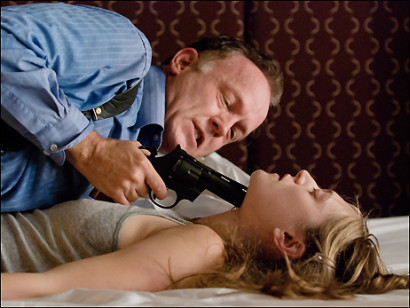
Blasted starts off with Ireland’s young Cate and Birney’s much older Ian entering a rather typical (if a bit more upscale) hotel room in Leeds.  Through Kane’s sparse but vitriolic dialogue, we also find out that the two characters used to be lovers.  Ian tries to coax Cate into bed with him, the latter resistant at first.  By the second scene, we find Cate lying in a blood-stained bed, evidence that Ian had had his way with her, after all.  Cate, realiing what had transpired the night before, comes to her sense and defends herself against Ian and escapes out the bathroom window.  Meanwhile, a knock on the door brings about Cancelmi’s soldier, who is unnamed.  After the soldier interrogates Ian and threatens hum with a gun, the hotel is blasted with a bomb.
At this point, the blackout (there are several of these in-between scenes) fades into the opening of the next scene, in which we find the room — and the characters — left amidst the dust and detritus, the walls torn apart by the explosion.  It is here where the drama becomes interesting, heightened by the soldier’s descriptions of war and violence.  There is one point made by the soldier that felt quite profound, wherein he asks Ian, a tabloid journalist, why the press does not frequently and accurately portray the destruction that happens during war.
Ian’s answer: “Because people don’t want to read about that.”
In class discussions, there was much mention of how our society, rife with domestic violence and murder, has become desensitized to certain types of violence, like the rape Ian inflicts on Cate in the play.  The audience, upon viewing, sees it in the distanced way most in our society do, as if to say: These things happen all the time, so why do I have to get involved?
 
In contrast, the brutalities one faces in war goes unnoticed, and when acted out a few feet in front of us, we cannot stomach such atrocity.  Kane’s intention is that we re-sensitize ourselves to the more gruesome images of violence, which we would normally see on the television, or hear about second-hand.  It says so much about the power of ephemera on the stage.
Of the three, it is Cancelmi’s performance as the soldier that stood out, mainly throughout the scene in which he interrogates and ultimately rapes Birney’s character.  During the interrogation, one can sense the demoralization he’d undergone as a result of war; the pain becomes all the more overwhelming to witness as his voice cracks when describing the rape and murder of his loved ones, and even more so when his weeps ring out ominously as he himself rapes Ian.
On that note, whilst the cast was certainly one to talk about, I think everyone who saw this production would agree that the real star was the set design.  The room, which fills up most of the stage space, gives one a voyeuristic feel, complimenting the characters’ extremely intimate interludes with one another throughout the first half of the play.  The interludes soon take an emotionally-charged turn, as we find the hotel room disheveled the “morning after,” Ian clearly having taken advantage of the young woman.  The disarray of what had been an almost perfect room reflected the change of pace within the plot, and would be a pre-cursor for the destruction to come.
Once the hotel is blasted, the original set of the hotel room is pushed back and the frame is all askew, exposing the steel that had held it up.  In the forefront are exposed floorboards, amongst broken furniture and debris.  No longer do we see the facade of a seemingly perfect world, but in its stead, a battleground.  This new battleground is both emotional and literal; it’s where our characters get caught in the crossfire, looking for a way out.
Never has there been so apt a time in which to give Sarah Kane’s play its New York premiere; it dares you to look, until you’re left wondering if you could ever tolerate witnessing such cruelty again.  Soho Rep’s Blasted is an emblem of our times — thought-provoking, cathartic and fearless.

Welcome to The Real: From Amsterdam to Berlin, The Public Theatre’s ‘Passing Strange’ Breaks Stereotypes and Crosses Boundaries

So, like three weeks later, here’s my review.

Oh. My. God.

I know — not very articulate of me in what is supposed to be a review, but suffice it to say that these are the only words that could describe my immediate reaction upon leaving the Belasco Theatre late Saturday night (5/31/08).

Before I get into things, however, I want to make a general “spoiler” warning here in lieu of a disclaimer. I am giving a very in-depth commentary, which includes a detailed synopsis, so if you are the type of person who does not like to know what happens beforehand, I suggest you ignore this post and scroll down to the Sex and the City trailer instead. Also, parenthetical references to songs are not necessarily in order — in fact, I may mention certain things out of order, so forgive me in advance if I’m a little less than lucid.

Ahem. With that said, I think I shall start here...


Passing Strange is the newest offering in the latest slew of so-called “rock musicals” to make it to the Great White Way. Co-created and narrated by Stew (of L.A.-based pop/rock duo The Negro Problem), this piece deals with themes of identity, love and what it means to be young. Its quizzical title comes from a quote in Shakespeare’s Othello, and as Stew explains in the Playbill: “[It] applies in the context of people ‘passing’ for what they are not — culturally, psychologically, and so on.”

This theme is carried out most prominently — and in such a moving way, might I add — by the character simply called The Youth, played by Daniel Breaker. Living in the predominantly black neighborhood of South Central, The Youth struggles with identity issues within the confines of his surrounding church community and family (especially that of his own mother), constantly refusing their urges for him to be more “black” (“Baptist Fashion Show”/”Mom Song”). This tug-of-war between who he feels he is and who he is expected to be in society leads him to go off on a soul-searching quest to Europe for what the local Reverend’s son terms as “The Real” (“Arlington Hill”).

First off, I want to just give my overall thoughts of Stew and his performance here, as well as that of the band’s (which includes co-creator Heidi Rodewald and her Shawn Colvin-like voice), before we get into the bulk of the story. Stew, the narrator and “emcee” of sorts, is just pure rock ‘n’ roll through and through, as he and the band start off our story (Prologue/ “We Might Play All Night”). At once a soulful gospel preacher, spoken-word poet and charismatic lead singer that could give Mick Jagger a run for his money, Stew wisely oversees The Youth’s journey and takes us along for a wild ride.

And what a wild ride, indeed.

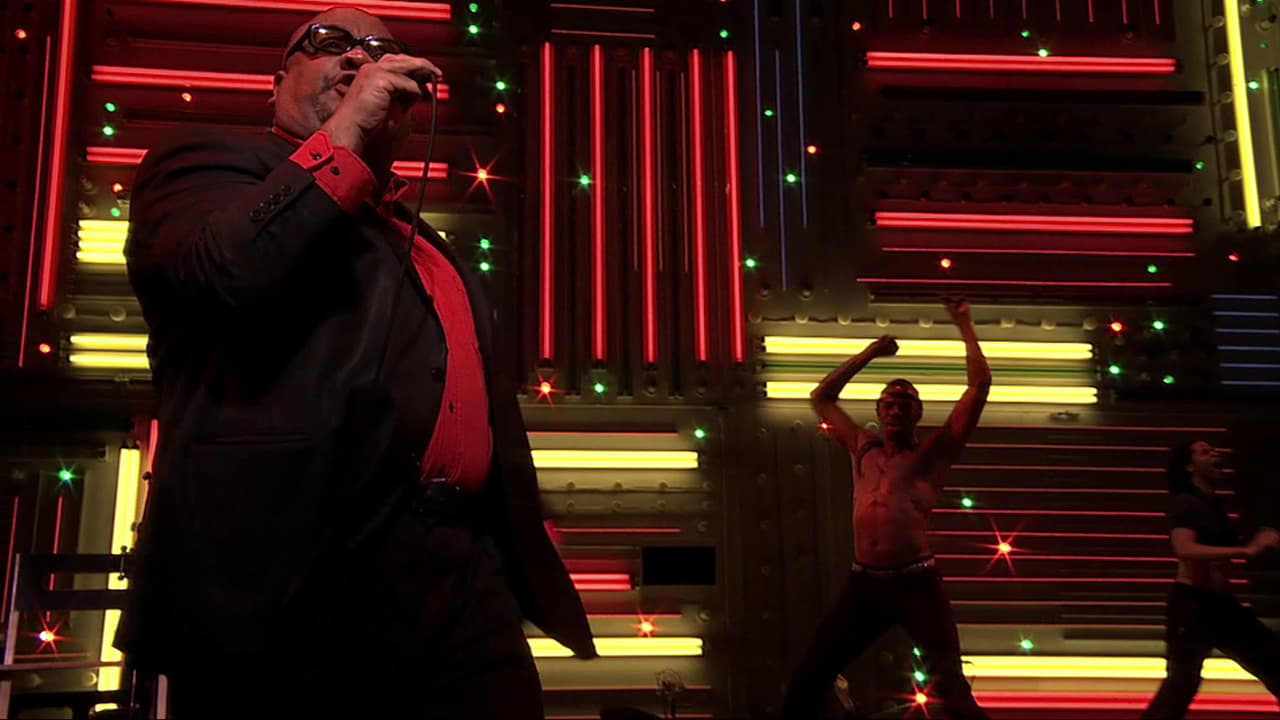
The story then unfolds on the streets of Amsterdam, where our Youth travels to find The Real. As The Youth walks into an artsy cafe, our eyes are gloriously blinded by a set of neon lights revealed on the back wall of the stage, conveying what I took to be signs of the city’s infamous Red Light District (“Amsterdam”). here, he meets a “neo-hippie” (as described in the Playbill) named Marianna, played by de’Adre Aziza, who notably looks past his skin color and offers him a place to stay (“Keys”).

Amidst freewheeling artists and moonlighters, The Youth finds himself swirled in a frenzy of mood-altering highs and steamy menages a trois — and then some. And whilst The Youth’s current surroundings are definitely sensual, it is at this stage that the story starts to take up much more humor as the comapny starts off the number, “We Just had Sex”, poking fun at that post-coital glow one may have after having multi-partnered relations.

Meanwhile, despite the heavenly bliss of legalized weed and sexual romps galore, our Youth discovers that one cannot write angsty, gut-wrenching rock songs whilst living in Paradise. So, “just when it was starting to feel real,” he takes off to new heights and settles in Berlin. It is there he meets a group of angry May ’68-ers (“May Day”), who are led by den mother Desi. Played to such strength and depth by Rebecca Naomi Jones, Desi’s seemingly tough exterior soon chips away as she and our hero fall in love (“Damage”). here, the humor continues on, as we meet Mr. Venus, an edgy performance artist, played to comedic perfection by Colman Domingo (who also played the Reverend’s son, Franklin). Also peppering snide yet witty comments throughout the Berlin section of play is Aziza as Sudabey, a rough-and-tumble avant-garde filmmaker, cracking some of the funniest one-liners of the night.

Aside from the injected humors, we also start to see the growing development of The Youth inner conflict, as he begins his new identity as a performance artist. Initially, disapproved of by the band of militant misfits, our hero tries to play up the non-existent “gangsta” life he claims to have led (“The Black One”). This thuggish facade fascinates the Berliners, who immediately welcome him with open arms — well, all except Desi, who suspects that our hero isn’t what he claims to be. She confronts him, but not long before he receives a phone call from his mother, who wants him to come home. We realize that The Youth still has much to learn in the way of love, especially in the way of a mother’s unconditional, unwavering emotion for her child. His turmoil soon climaxes as he tries to work out all that is going on between his love for Desi, as well as that for his mother back in L.A.

Soon, our Youth finds himself flying back to L.A. for his mother’s funeral, and finally comes to terms with the fact tht no matter what his identity — whether it be artist extraordinaire or wailing troubadour, his mother would have still loved him all the same (“Work the Wound”/ “Passing Phase”). In the realization of this, we as the audience realize that the Youth’s whole story had been somewhat of an autobiography, as we see Stew face our hero and look at his past self. He tells the Youth all that he’s learnt, that however much he’s tried, his mother would never come back. Our hero insists otherwise, stating that it is in the continuation of his art, through which he shall funnel all the love and regret he’s had for both his mother’s death, and its aftermath.

It is here that one of my favorite quotes from the show is uttered, by Breaker’s character: “Life is a mistake only art can correct.” So much is said by these few words, and the fact that they were voiced through The Youth speaks volumes about the general hopefulness one possesses when they’re young. In many ways, it’s what this show is all about, that in your twenties life can be full of possibilities only when you choose to go out and explore them.

While this sentiment definitely resonated with me, it was the narrator’s woeful doubts that I believe touched me the most. Stew’s performance played out in such a way that saddened me, as if to him it was impossible to believe in The Real anymore. Indeed, as he and co-collaborator start off “Love Like That”, he makes it clear that The Real “is a construct,” and that the only place people can ever really experience The Real is through art.

They say that “Life imitates art,” and it is clear in Stew’s storytelling. The libretto is such a unique piece, fresh and vibrant, with themes that leave you with something more than what you expected when you entered the theatre. With a well-rounded cast — which also includes Eisa Davis as The Youth’s mother, and Chad Goodridge — breathing life to multiple roles, and a heart-pounding, trippy score just as psychedelic as The Youth’s journey, Passing Strange is definitely a show that has staying power in the current, ever-changing climate of Broadway musicals.


Images courtesy of themoviedb.org. Passing Strange ran from February 28-July 20, 2008 at the Belasco Theatre (111 West 44th Street).